Category: Uncategorized

  • Why Restaurant Owners Shouldn’t Have to Negotiate an MCA

    HomeBlog › MCA

    MCA · 2026-03-05 · By Daniel Harper

    Why Restaurant Owners Shouldn’t Have to Negotiate an MCA

    Why Restaurant Owners Shouldn’t Have to Negotiate an MCA

    Restaurant owners should not enter an MCA negotiation where the provider controls the structure, the repayment terms, and the leverage before the conversation even begins. Traditional merchant cash advances frequently rely on take-it-or-leave-it terms that pressure cash flow and restrict flexibility. Owner-driven restaurant financing puts the starting point back in the owner’s hands.

     

    Dine_Well_Financial_Restaurant_MCA_Leverage_Comparison


    Why MCA Negotiation Is a Losing Game for Restaurant Owners

    Merchant cash advances are often sold as quick funding for restaurant owners who need working capital fast. The pitch sounds appealing: approval is easier than traditional small business loans, money arrives quickly, and repayment comes out of daily revenue instead of monthly installments.

    On the surface, that sounds like a modern solution for restaurants facing tight timelines.

    But what many operators discover is that the real pressure starts after the offer is on the table.

    Negotiating an MCA is rarely a fair process. The provider sets the structure, the factor rate, the withdrawal schedule, and the default terms before you even speak. Restaurant owners are left reacting, not choosing.

    And the cost is not always as straightforward as it looks upfront. Many MCA agreements come layered with extra charges that don’t show up in the headline number, things like origination costs, administrative fees, document charges, or processing add-ons that quietly increase the total payback.

    That imbalance matters because restaurants operate with thin margins, unpredictable sales, and constant operational demands. You should not have to bargain for survival financing.


    MCA Providers Control the Starting Point

    In most MCA models, the provider sets the advance amount, the repayment total, and the daily deduction percentage before you are even part of the conversation. They outline the repayment schedule and embed enforcement tools directly into the agreement.

    So when the paperwork reaches you, the structure is already built. You are not shaping terms. You are reacting to a framework designed in the provider’s favor.

    That is not leverage. It is simply trying to limit the downside after the key decisions have already been made.


    Why Restaurants Are Especially Vulnerable

    Restaurants deal with seasonal revenue swings, rising food and labor costs, and high daily operating expenses that do not pause when sales dip. Add in volatile credit card receipts, and you have an industry where cash flow can change week to week.

    That volatility is exactly why owners deserve financing terms built around reality, not rigid repayment structures imposed from the outside.

    When cash flow is tight, owners often accept the first offer available. That urgency is exactly what MCA providers rely on.

    Negotiation becomes less about fairness and more about desperation.

     

    Dine_Well_Financial_Merchant_Cash_Advance_Negotiation_Risk


    Why MCA Negotiation Feels One-Sided From the Start

    The word “negotiation” implies two parties sitting at the table with equal ability to walk away. But that is rarely how merchant cash advances work in practice.

    Restaurant owners usually seek funding because something is urgent. Payroll is due. A refrigerator breaks. Inventory costs spike unexpectedly. A slow season stretches longer than planned.

    In those moments, the owner is not negotiating for advantage. They are negotiating for survival.

    That urgency shifts the balance immediately. MCA providers know the restaurant needs speed, and speed becomes the justification for terms that would never survive scrutiny in traditional lending.

    Even when an owner asks for better repayment terms, the structure itself stays rigid. The provider may adjust the numbers slightly, but the daily deduction model remains the same.

    If you’re wondering how much of this one-sided structure is simply standard practice versus something that raises legal concerns, it’s worth digging deeper. In our previous article, Merchant Cash Advances: Are They Even Legal for Restaurants?, we break down the legal gray zones, enforcement risks, and why transparency matters just as much as speed when choosing restaurant funding.

    This is why so many restaurant operators walk away from MCA agreements feeling like they never truly had a choice.


    The Reality Behind “Fast Business Funding”

    Speed can feel like relief, but it often comes with:

    • High-interest rates hidden behind factor rates
    • Fixed daily payments regardless of sales drops
    • Limited flexibility if business slows
    • Increased risk to the merchant account

    The negotiation is not about what you can afford. It is about what the provider can extract.


    Negotiation Doesn’t Fix the Core Problem

    Even if you negotiate slightly better terms, the structure stays the same.

    Daily repayment pressure remains. Short-term financing stress remains. Provider-first contract language remains. Limited refinancing options remain.

    The power imbalance remains.

    This is what makes MCA “negotiation” feel fake. When you need money fast, you don’t walk in with leverage, you walk in with urgency.

    I did some research and found out that some small businesses, especially those that are looking to receive funds quickly, turn to nonbank lenders to meet their financing needs, and once you’re in that lane, offers often come as preset terms with limited room to shape the deal around your real cash flow. 

    That reality explains why restaurant owners often feel cornered into accepting MCA offers rather than negotiating from strength.

     

    Dine_Well_Financial_Restaurant_Cash_Flow_Repayment_Pressure


    The Restaurant Funding Market Should Work Differently

    Most restaurant operators would never accept a supplier contract where the supplier sets the price, the penalties, and the collection rights unilaterally.

    Yet that is exactly how many MCA agreements function.

    The funding marketplace has historically placed all control with the provider. Owners are told to accept the offer or walk away.

    That is not a sustainable model for long-term business growth.

    Restaurants already operate in a high-pressure environment. Financing should reduce stress, not add to it.


    A Better Model: You Propose the Rate First

    This is where Dine Well Financial shifts the structure.

    Instead of sitting across from a lender reacting to preset terms, restaurant owners begin by outlining what actually works for their business. That includes how much capital they need, what repayment feels realistic within their cash flow, and the rate or repayment range they believe is fair.

    From there, the request is shared with a network of vetted, restaurant-focused lenders. Those lenders review your proposed terms and respond accordingly. Some match them. Some counter. The conversation starts from your baseline, not theirs.

    The leverage changes when you are the one setting expectations first.


    Why This Shift Matters So Much

    Restaurant owners negotiate constantly. Vendor pricing gets negotiated. Staffing schedules get adjusted. Lease terms get discussed. Food costs are managed line by line.

    Restaurant financing should follow the same logic.

    When you name your own rate and define a repayment range that protects your business, you apply the same discipline you use everywhere else. The focus stays on sustainability, not urgency. Capital supports operations instead of pressuring them.

    That shift is not cosmetic. It changes how funding fits into your long-term strategy.

    Dine_Well_Financial_Restaurant_Funding_Power_Dynamics

    Key Differences in Power Dynamics

    Before choosing any restaurant financing structure, it helps to understand who controls the terms from the beginning. The difference is not just about repayment mechanics. It is about leverage. In most MCA agreements, the provider dictates structure and the restaurant adapts. In an owner-driven model, that order reverses.

    Traditional MCA Model Dine Well Financial Model
    Provider sets terms first Owner proposes terms first
    Fixed repayment pressure Offers aligned to expectations
    Limited flexibility Built around cash flow reality
    Negotiation favors lender Control stays with the owner
    High risk of repayment panic Reduced risk through transparency

    This comparison highlights more than product differences. It shows a shift in control. In most MCA deals, the structure is already built before the restaurant has input. You’re left adjusting to it. Change that order, and the leverage shifts. That reversal changes risk exposure, negotiation leverage, and long-term financial stability.


    What Owner Control Actually Looks Like

    Owner-driven financing is not a slogan. It changes how the process actually works.

    You see the repayment clearly before signing. The offers that come back are closer to what you expected, and you can compare options without feeling boxed in or rushed.

    More importantly, the funding process reflects the operational reality of restaurants.

    Restaurants run on fluctuating revenue, unexpected costs, and constant moving parts. A smart funding structure accounts for that variability instead of ignoring it.

    Financing should adjust to the business in front of it, not penalize it for being real.


    Common Signs You Should Not Be Negotiating an MCA

    Here are a few signals that an MCA negotiation is not worth continuing:

    • You feel rushed to sign
    • The provider will not explain total repayment cost
    • Daily deductions exceed your profit margin
    • The contract includes aggressive default clauses
    • You are relying on short-term funding to cover operational gaps

    Negotiation will not fix a structure that is fundamentally misaligned with your business reality.

    A Simple Rule Restaurant Owners Can Use

    If the funding offer is built around what the provider wants first, not what your restaurant can actually repay, it is not a negotiation.

    It is a trap with paperwork.

     

    Dine_Well_Financial_Alternative_To_MCA_Negotiation


    Restaurant Financing Should Support Growth, Not Trap Owners

    Restaurants seek funding for expansion, equipment updates, inventory purchases, and ongoing working capital support. Those are normal parts of running and scaling a business.

    The problem is not financing itself. The problem is when a financing solution creates rigid repayment stress that limits flexibility and slows momentum.

    Owner-driven models approach this differently. They take restaurant operations into account and structure terms around how the business actually performs, rather than forcing owners into lender-first contracts built for the provider’s protection.

    Funding should strengthen business growth, not quietly restrict it.


    Choose Restaurant Financing That Puts Owners Back in Control

    Restaurant owners should not have to negotiate against MCA providers who hold all the leverage. Traditional merchant cash advances often create repayment structures that prioritize the lender, not the business.

    Dine Well Financial offers a different path: you propose your own rate first, lenders respond, and you choose the best fit based on transparency and control.

    If your restaurant needs funding, consider a model built around your cash flow reality and long-term stability. A simple conversation with Dine Well Financial can help you explore owner-driven options that avoid negotiation traps and keep your business in control. Contact us today.


    Disclaimer: Dine Well Financial is not a lender and does not provide merchant cash advances or business loans directly. We are a funding network that connects restaurant owners with third-party lenders and capital providers. All financing offers are subject to lender approval and applicable underwriting criteria. “Name your rate” is a non-binding feature that allows business owners to propose preferred repayment terms; actual offers may differ based on creditworthiness, business performance, and lender discretion. Dine Well Financial makes no guarantees regarding funding availability, terms, or lender acceptance. Always consult with a financial advisor or legal professional before entering into any financing agreement.

    Portrait of Daniel Harper
    Daniel HarperRestaurant Finance Editor, Dine Well Financial

    Daniel Harper writes about restaurant financing, merchant cash advance risk, and cash flow strategy for Dine Well Financial. His work focuses on helping independent restaurant owners compare funding options with clear numbers before they sign anything. He has covered alternative lending for the food service industry since 2019. More from Daniel Harper.

    Fast, Transparent, Nationwide

    Stuck in an MCA or comparing funding options?

    You shouldn’t have to wait weeks for what you need today. Call now or apply online in minutes. With our easy application, many clients receive funds in just a few days, subject to lender approval and qualifications.


  • What Happens If You Can’t Repay an MCA (And How to…

    HomeBlog › MCA

    MCA · 2026-02-19 · By Daniel Harper

    What Happens If You Can’t Repay an MCA (And How to Choose a Safer Option)

    What Happens If You Can’t Repay an MCA (And How to Choose a Safer Option)

    If you can’t repay a merchant cash advance, daily withdrawals often continue even when sales drop, putting immediate pressure on restaurant cash flow. Payment processing disruptions and fast-moving collections can follow, leaving owners with little room to recover. Safer restaurant financing options focus on flexible repayment so a short downturn doesn’t become a crisis.


    Dine_Well_Financial_merchant_cash_advance_risks_restaurants


    The Hidden Risk Behind Fast Merchant Cash Advances for Restaurants

    Merchant cash advances promise speed when you need working capital quickly. Traditional bank loans can feel out of reach, especially if your credit score is not perfect. MCAs offer fast approval, minimal paperwork, and funding based on credit card sales rather than creditworthiness. That speed feels like a solution for restaurant owners navigating constant financial pressure.

    But restaurants operate on thin margins and unpredictable revenue. Seasonal swings, labor costs, and food price volatility keep cash flow fragile. When repayment terms stay rigid and disconnected from real-time performance, fast funding turns into a financial strain. The alternative lending industry markets MCAs as flexible capital with quick access and no collateral, yet that convenience often comes at a much higher long-term cost.

    I did some research and found out that the Federal Trade Commission documented merchant cash advance operators using “predatory contract terms” against small businesses, leading to enforcement action and permanent industry bans.

    That enforcement matters. It shows how some MCA agreements protect the lender first, even when repayment becomes unsustainable for your business. Daily withdrawals continue regardless of revenue declines. You absorb all the risk while lenders stay insulated. This imbalance turns a short-term funding solution into a long-term operational threat.


    What a Merchant Cash Advance Really Is

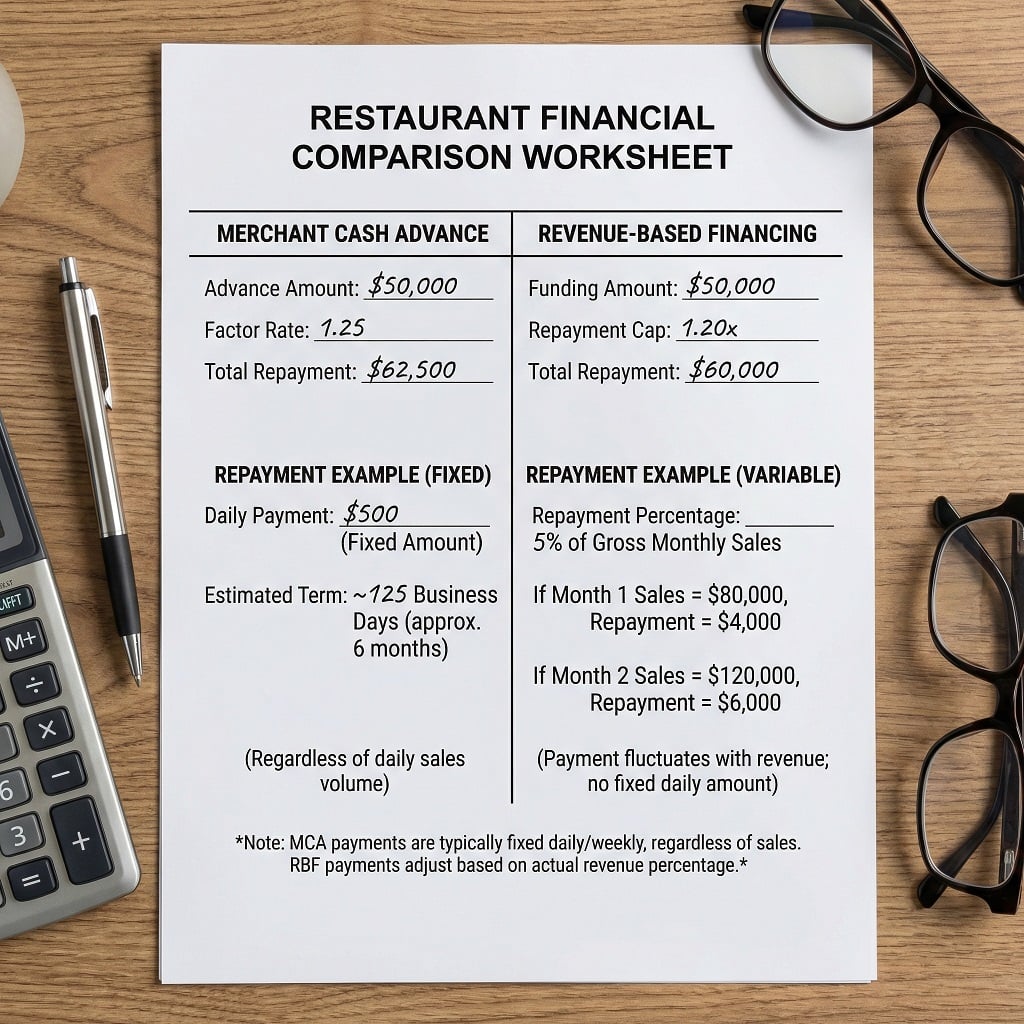
    A merchant cash advance is not a traditional small business loan. It’s an advance against future credit card receivables. Repayment happens through daily sales deductions or automated clearing house (ACH) withdrawals from your merchant account. Instead of interest rates, MCAs use a factor rate. This fixes your total repayment amount from day one.

    Here’s what that means in practice. You take a $50,000 cash advance with a factor rate of 1.3. You owe $65,000 total. That $15,000 difference gets pulled from your daily credit card sales until the full amount is paid.

    Repayment doesn’t adjust based on revenue fluctuation. Your daily credit card sales rise or fall, but the same percentage gets pulled until you hit the fixed payback. For restaurants managing business cash flow, that rigidity creates problems fast.


    Dine_Well_Financial_MCA_daily_withdrawal_impact


    Why MCA Repayment Becomes Risky During Revenue Drops

    Your restaurant relies on inconsistent revenue streams. Weather changes affect foot traffic. Tourism cycles shift. Staffing shortages happen. Supplier costs spike. All of this impacts your daily credit card transactions.

    When sales dip, MCA repayment doesn’t slow down to protect restaurant cash flow. Your operational expenses stay the same. Rent doesn’t drop because you had a bad week. Payroll doesn’t shrink because fewer customers walked through the door.

    You face a choice. Cover payroll, rent, and inventory purchases or keep up with repayment. Many restaurant owners turn to additional short-term financing, business cash advances, or other loan alternatives. Obligations stack. Financial strain increases.

    This is where the debt cycle begins. You take one advance to cover immediate needs. Sales don’t recover fast enough. You take another advance to cover the first. Soon you’re juggling multiple repayment schedules, each one pulling from the same shrinking pool of daily sales.


    What Cash Flow Pressure Looks Like in Practice

    The pressure starts subtle. Vendor payments get delayed. Repairs get postponed. You cut labor too aggressively. Meanwhile, the MCA debit keeps coming. Every morning, the daily withdrawal hits your account before you’ve even opened the doors.

    Over time, that pressure blocks investments that improve performance. Restaurant equipment financing gets pushed aside. Restaurant renovation waits. Marketing initiatives stop. Instead of supporting business growth, the funding drains your operational flexibility.


    What Happens If You Can’t Repay an MCA

    Repayments fall behind. Escalation comes fast. Many MCA agreements let providers disrupt payment processing, redirect credit card receivables, or launch aggressive collection efforts tied to personal guarantees.

    You miss a few daily payments when your account balance dips too low. ACH attempts fail. The MCA provider reaches out immediately, referencing the merchant agreement you signed. Clauses within that agreement may allow an increase in the daily withdrawal percentage.

    In some cases, escalation goes further. Providers may contact your credit card processing company directly and redirect future sales to themselves before funds reach your account. The result is a loss of control over your own merchant account.

    MCAs often sit outside traditional small business lending protections. You have limited options once default remedies trigger. This damages your financial health, restricts capital access, and stalls restaurant business growth.


    Common Default Triggers That Catch Restaurant Owners Off Guard

    • Missed daily payments or returned ACH debits
    • Sudden drops in sales volume
    • Switching credit card processing providers without approval
    • Frequent overdrafts in your merchant account
    • Failure to provide updated bank statements during review


    Dine_Well_Financial_small_business_funding_risks


    Early Warning Signs Repayment Is Becoming Unsustainable

    Most restaurants see warning signs before full default hits. Recognize them early. You prevent deeper damage.

    • Daily sales deductions exceed your net profit margin
    • Difficulty covering payroll or inventory purchases on time
    • Reliance on additional short-term funding to stay afloat each month
    • Declining revenue paired with fixed repayment terms
    • Ongoing stress around cash flow management that keeps you up at night

    When repayment terms are designed to escalate instead of adapt, even a temporary slowdown can trigger permanent consequences. By the time default remedies activate, the damage to cash flow and operations is already underway. This is why repayment structure matters just as much as access to capital.


    The Long-Term Impact on Restaurant Growth

    Restaurants locked into rigid MCA repayment structures delay restaurant expansion. Equipment financing waits. Improvement projects stall. Capital meant for growth gets redirected toward survival.

    Think about what that means for your vision. You opened your restaurant with plans to grow. Maybe that meant opening a second location, adding catering, or upgrading the kitchen to roll out a new menu. Those were real next steps, not abstract ideas.

    Merchant cash advances drain that potential. Every dollar pulled in daily repayments is a dollar you can’t invest in business growth. This weakens your business credit over time. It affects creditworthiness. It limits access to healthier restaurant financing options. What begins as quick funding quietly caps your long-term potential.


    Dine_Well_Financial_cash_flow_management_restaurants


    Comparing MCA Risk to Safer Restaurant Financing Options

    Not all business funding solutions carry the same risk level. The key difference is how repayment behaves when revenue fluctuates.

    Funding Option Repayment Structure Risk Level Cash Flow Impact
    Merchant Cash Advance Fixed daily deductions High Severe strain during slow periods
    Short-Term Business Loan Fixed payments Medium Predictable but inflexible
    Revenue-Based Financing Payments adjust with sales Lower Aligned with volatility
    Traditional Bank Loan Monthly payments Low Requires strong credit
    Owner-First Marketplace Owner-defined repayment terms Lower Built around affordability


    Traditional bank loans offer the lowest interest rates and the most favorable terms, but qualifying is tough. You need strong business credit, solid financial statements, often collateral, and patience for a slow approval process.

    Short-term business loans from online lenders move faster than banks. Approval takes days instead of months. But repayment terms stay fixed. If your sales drop, your payment stays the same.

    Revenue-based financing ties your payment to actual sales performance. Good month means higher payment. Slow month means lower payment. This aligns with the reality of restaurant revenue cycles.

    Merchant cash advances sit at the high-risk end. Factor rates often translate to APRs of 40% to 200% or more. Daily withdrawals hit regardless of performance. The total cost of capital far exceeds any other option.


    Dine_Well_Financial_restaurant_business_growth_financing


    How to Choose a Safer Option and Avoid Repayment Panic

    Safer restaurant financing comes down to control and transparency. When repayment reflects how a restaurant actually earns money, it becomes easier to stay steady during slow periods instead of scrambling to catch up.

    Before signing any agreement, it helps to think through how it would hold up during a bad month. If sales drop, does repayment adjust or stay fixed no matter what. Restaurants do not operate on perfect weeks, and financing that assumes they do often creates problems later. Cost matters as well. Factor rates can hide how expensive capital really is, so calculating the actual APR and comparing alternatives can change how a deal looks.

    It is also important to understand what happens if circumstances change. Some MCA agreements leave little room to restructure, refinance, or exit early without penalties. Others rely on personal guarantees that put personal assets at risk. Those details may feel distant at signing, but they become very real once cash flow tightens.

    Dine Well Financial approaches funding differently. Restaurant owners define what they can realistically repay, and lenders respond within those limits.

    If you are weighing options or trying to understand an existing agreement, we at Dine Well Financial invites restaurant owners to reach out for a straightforward conversation about cash flow and repayment comfort.


    Disclaimer: Dine Well Financial is not a lender and does not provide merchant cash advances or business loans directly. We are a funding network that connects restaurant owners with third-party lenders and capital providers. All financing offers are subject to lender approval and applicable underwriting criteria. “Name your rate” is a non-binding feature that allows business owners to propose preferred repayment terms; actual offers may differ based on creditworthiness, business performance, and lender discretion. Dine Well Financial makes no guarantees regarding funding availability, terms, or lender acceptance. Always consult with a financial advisor or legal professional before entering into any financing agreement.

    Portrait of Daniel Harper
    Daniel HarperRestaurant Finance Editor, Dine Well Financial

    Daniel Harper writes about restaurant financing, merchant cash advance risk, and cash flow strategy for Dine Well Financial. His work focuses on helping independent restaurant owners compare funding options with clear numbers before they sign anything. He has covered alternative lending for the food service industry since 2019. More from Daniel Harper.

    Fast, Transparent, Nationwide

    Stuck in an MCA or comparing funding options?

    You shouldn’t have to wait weeks for what you need today. Call now or apply online in minutes. With our easy application, many clients receive funds in just a few days, subject to lender approval and qualifications.

  • This Restaurant Used an MCA and Regretted It Here’s What…

    HomeBlog › MCA

    MCA · 2026-02-23 · By Daniel Harper

    This Restaurant Used an MCA and Regretted It Here’s What They’d Do Instead

    This Restaurant Used an MCA and Regretted It Here’s What They’d Do Instead

    This restaurant thought a merchant cash advance would solve a short-term cash flow problem. Instead, it narrowed their options, stalled business growth, and forced operational tradeoffs they did not expect. Looking back, they would have chosen a restaurant financing process that let them set the terms and stay in control.


    Dine_Well_Financial_Restaurant_Used_An_MCA


    When Cash Pressure Forced a Fast Choice

    The restaurant was busy, well-reviewed, and operating at full capacity, but timing worked against them. A recent restaurant renovation drained reserves, and seasonal revenue dips common in the restaurant industry slowed recovery. At the same time, fixed operational expenses did not pause. Payroll, inventory purchases, and vendor payments all hit within the same window.

    None of those capital needs were optional. Expenses piled up fast, forcing decisions that usually would have unfolded over months. Expansion was not the goal. Protecting operations and stabilizing restaurant cash flow was.

    Waiting weeks for traditional bank loans or small business loans felt unrealistic. Speed took priority over structure, and the fastest business funding option became the one they chose.

    The pressure felt immediate. Every day without a solution meant vendors calling, staff asking questions, and the owners losing sleep. When you are in that position, quick funding sounds less like a choice and more like survival.


    How the Decision Got Made Under Pressure

    A merchant cash advance promised quick funding with minimal friction. Approval did not hinge on a strong business credit score or collateral. Instead, it focused on credit card sales, sales volume, and access to the restaurant’s merchant account.

    The MCA provider made it sound simple. There was no complicated loan application, waiting for bank statements to be reviewed by committees or personal guarantee tying the owner’s home to the deal. They just needed proof of daily sales and access to credit card processing.

    The money arrived quickly as a lump sum payment, and at the time it felt like a practical form of short-term financing. The owners believed they were buying breathing room to stabilize working capital.

    What they did not yet understand was how the repayment structure would affect daily decision-making once repayment began. Nobody from the cash advance provider explained what happens when sales volume drops. Nobody walked them through how daily withdrawals would feel during a slow week.

    The paperwork moved fast. Questions went unanswered. The focus stayed on funding speed, not repayment terms.


    Dine_Well_Financial_restaurant_financing_mistake


    When Short-Term Relief Became Long-Term Constraint

    Once repayment started, the pressure shifted. Cash was no longer just tight. It was already allocated before it even hit the account.

    I did some research and found out that cash credit constraints can force entrepreneurs to forgo investment opportunities in order to finance their working capital needs, a pattern documented in economic research on small business decision-making.

    That pattern showed up almost immediately. Daily repayment pulled directly from daily credit card sales, limiting flexibility. Money that could have gone toward restaurant equipment financing, marketing, or staffing was no longer accessible. The restaurant’s financial health did not collapse, but its ability to act strategically disappeared.

    The automated clearing house (ACH) withdrawal hit the merchant account first thing in the morning. By the time the doors opened, the available balance was already lower. The owners watched their POS system tracking sales, doing mental math on what would be left after the daily deduction.

    Cash flow management became an obsession. They stopped thinking about growth. They started thinking about survival.


    What Looked Fine at First

    In the first few weeks, the daily payments felt manageable. Strong sales helped absorb the deductions, and the advance blended into normal cash flow management.

    That did not last. Seasonal dips and revenue fluctuation made the fixed withdrawals more visible. Unlike revenue-based financing with true flexible repayment options, this structure did not adjust when sales slowed.

    A rainy week meant fewer customers. Fewer customers meant lower daily credit card transactions. Lower transactions meant the factor rate took a bigger percentage of what came in. The MCA did not care about weather, staffing issues, or supplier problems. The repayment schedule stayed locked.

    Spending became cautious. Decisions around inventory financing, repairs, and staffing were delayed. The restaurant stayed operational, but every choice became reactive. Planning stopped. Firefighting started.


    The Missed Opportunities That Added Up

    The regret did not come from using alternative lending. It came from what the restaurant could not do afterward.

    They wanted to upgrade their aging restaurant equipment. The walk-in cooler was struggling, the oven needed replacement, and outdated POS systems were slowing everything down. But every dollar was spoken for. Equipment financing was not an option because cash flow was already maxed out.

    A food blogger reached out about a collaboration. It would have driven foot traffic and boosted their profile. But they could not afford the extra inventory needed to handle the surge. They turned it down.

    A competitor opened down the street with a bigger space and better ambiance. The owners knew they needed to refresh their dining room to stay competitive. Restaurant renovation got pushed indefinitely. Customers started noticing. Reviews mentioned the tired decor.


    Dine_Well_Financial_restaurant_growth_stalled


    The Tradeoffs No One Talks About Up Front

    At signing, none of these consequences were obvious. The focus was on quick access to funds, not on how restricted business cash flow would feel later.

    • Planned restaurant equipment upgrades were postponed, slowing service and efficiency
    • A marketing campaign meant to drive restaurant business growth was canceled
    • Hiring was delayed, increasing pressure on existing staff and affecting service quality
    • Preventive maintenance was deferred, turning small issues into larger operational costs
    • Menu innovation stopped because testing new dishes required capital investment
    • Payroll management became stressful as hours got cut to preserve cash flow

    Individually, each choice felt reasonable. Together, they stalled momentum and limited business growth strategies. The restaurant was not failing, but it was not thriving either. It was stuck.


    Why Control Mattered More Than Speed

    Looking back, the issue was not capital access. It was who controlled the terms.

    The restaurant accepted funding terms set entirely by the lender. There was no ability to propose repayment terms aligned with real margins, no opportunity to compare funding options, and no exit flexibility.

    The merchant cash advance agreement locked them in. They could not refinance, pay off early without penalties or renegotiate when sales dropped. The MCA provider held all the cards.

    Speed solved a short-term problem. Structure dictated long-term stress.

    When the owners finally sat down with their accountant, the numbers told a brutal story. The factor rate translated to an APR of over 60%. They had paid nearly double what a traditional business loan would have cost, and they were still months away from being free of the daily withdrawals.

    The APR shock was bad enough. But the accountant also flagged something else: the MCA was creating a mess in their books. How do you categorize something that is not technically a loan or record daily deductions that do not fit cleanly into revenue or debt? The confusion does not just complicate financial reporting. It creates real tax problems that show up months later. If you want to understand how merchant cash advances turn into accounting nightmares and what you need to know before tax season hits, read our guide on The Tax Trap of Merchant Cash Advances, And How to Avoid It. Your books deserve better than guesswork.


    A Clear Comparison the Owners Wish They Had Seen

    Only later did the owners understand that not all fast business funding behaves the same way. The difference is whether the restaurant owner sets expectations first.


    Funding Approach Who Sets the Terms Repayment Flexibility Impact on Decisions
    Merchant cash advance Provider None Defensive decision-making
    Small business loan Financial institution Limited Clear but slower
    Owner-led rate proposal Restaurant owner High Controlled growth


    Seeing these business loan alternatives side by side changed how they viewed funding entirely.

    Traditional bank loans give you fixed monthly payments and clear interest rates. You know exactly what you owe, and your repayment does not change based on daily sales performance, but qualifying takes time and requires strong creditworthiness.

    Short-term business loans from online lenders move faster than banks. You still get a clear loan agreement with defined terms, but approval standards stay rigid and repayment stays fixed.

    Owner-led funding marketplaces flip the script. You define what you need and what you are comfortable paying. Lenders compete for your business instead of you begging for theirs, and you stay in control from start to finish.


    Dine_Well_Financial_restaurant_working_capital_crisis


    What They Would Do Instead

    With hindsight, the owners would start with their own limits. They would define a repayment level that worked even during slower weeks, protecting restaurant cash flow management first.

    Instead of accepting preset offers, they would propose their own rate, compare responses from funding providers, and choose terms aligned with their reality. The goal would be sustainable restaurant funding, not just speed.

    They would ask harder questions upfront.

    • What happens if sales drop 20%?
    • Can I refinance if I find better terms?
    • What is the true cost of this capital when calculated as an APR?
    • How does this affect my business credit and future capital access?

    Most importantly, they would choose a process that allowed them to walk away. Control would come before commitment. No more signing under pressure or accepting terms designed to benefit the lender first.


    Where Dine Well Financial Changes the Outcome

    Dine Well Financial exists to prevent exactly this scenario. Instead of forcing restaurant owners into rigid structures, the process starts with the owner. You name your own rate, funding amount, and repayment comfort level upfront.

    That request goes to a curated funding marketplace of restaurant-focused lenders. Offers come back aligned to those expectations, giving owners real choice before committing to business financing.

    This approach supports long-term restaurant business financing without sacrificing flexibility. Capital works with your business model, not against it. Repayment terms adjust to your reality. And instead of confusion, you gain real transparency.

    Dine Well does not push funding products. It creates a space where restaurant owners set the rules and lenders respond. That shift in power makes all the difference.


    Dine_Well_Financial_restaurant_business_financing_story


    The Lesson This Restaurant Learned

    Quick funding solutions feel like relief under pressure. Loss of control shows up later.

    Once flexibility disappears, business growth opportunities quietly fade. Better outcomes start by setting terms before pressure takes over.

    The owners are still running their restaurant. They paid off the MCA and survived, but they lost a year of growth they will never get back. The restaurant watched competitors pull ahead while they stayed stuck in repayment mode.

    If you are considering restaurant funding options, learn from their experience. Start with what you are comfortable repaying, not what is being offered. Ask about repayment flexibility. Compare funding solutions before you commit. Read the loan agreement carefully. Understand the true cost.

    Do not let cash flow pressure force you into a bad deal. Better options exist. You just need to know where to look.

    If you want to stay in control of your next funding decision, we at Dine Well Financial invite restaurant owners to reach out for a straightforward conversation about structure, flexible repayment, and funding that works with real restaurant operations.


    Disclaimer: Dine Well Financial is not a lender and does not provide merchant cash advances or business loans directly. We are a funding network that connects restaurant owners with third-party lenders and capital providers. All financing offers are subject to lender approval and applicable underwriting criteria. “Name your rate” is a non-binding feature that allows business owners to propose preferred repayment terms; actual offers may differ based on creditworthiness, business performance, and lender discretion. Dine Well Financial makes no guarantees regarding funding availability, terms, or lender acceptance. Always consult with a financial advisor or legal professional before entering into any financing agreement.

    Portrait of Daniel Harper
    Daniel HarperRestaurant Finance Editor, Dine Well Financial

    Daniel Harper writes about restaurant financing, merchant cash advance risk, and cash flow strategy for Dine Well Financial. His work focuses on helping independent restaurant owners compare funding options with clear numbers before they sign anything. He has covered alternative lending for the food service industry since 2019. More from Daniel Harper.

    Fast, Transparent, Nationwide

    Stuck in an MCA or comparing funding options?

    You shouldn’t have to wait weeks for what you need today. Call now or apply online in minutes. With our easy application, many clients receive funds in just a few days, subject to lender approval and qualifications.

  • The Tax Trap of Merchant Cash Advances and How to Avoid It

    HomeBlog › MCA

    MCA · 2026-02-21 · By Daniel Harper

    The Tax Trap of Merchant Cash Advances and How to Avoid It

    The Tax Trap of Merchant Cash Advances and How to Avoid It

    Merchant cash advances can create tax problems because they sit in a gray area between a loan and a sale. When you accept that gray area, you deal with the consequences later as your books stop lining up cleanly and questions begin to pile up. Choose financing that is clearly structured from the beginning, and you make those problems far easier to avoid.


    Dine_Well_Financial_merchant_cash_advance_risks


    Why Merchant Cash Advances Create Tax Confusion for Restaurants

    Merchant cash advances are often presented as simple solutions. You receive a lump sum, and repayment pulls automatically from your sales as revenue comes in. If you already manage daily swings in income, that structure can feel familiar and easy to accept, especially when speed matters.

    The problems rarely appear at signing. They show up later, when you or your accountant have to explain what the transaction actually was. Many merchant cash advance agreements avoid loan language altogether, making it harder to classify the funding cleanly once you review the books or prepare taxes. What looks like straightforward business financing at first can quickly become a gray area.

    I did some research and found out that a merchant cash advance is described by financial guidance as an arrangement where the provider purchases a portion of your future credit and debit card sales instead of issuing a traditional loan.

    That framing explains why so many restaurant owners run into problems later. When you document funding as a sale instead of debt, you lose a clean breakdown between principal and cost. Money leaves your business account every day, yet the paperwork fails to clearly define how you should treat those dollars. That is when accountants start asking questions the agreement never addressed.


    How Merchant Cash Advances Blur the Line Between a Loan and a Sale

    With a traditional loan, there is little to debate. You borrow money, repay the principal, and track interest separately. Everyone involved understands the transaction. Your financial statements clearly reflect the debt, and your CPA knows exactly how to categorize it.

    Merchant cash advances work differently. The provider purchases a portion of your future sales and continues collecting until the agreed amount is delivered. On paper, the transaction looks like a sale. In practice, it feels like debt financing. Money leaves your account day after day, yet the agreement often fails to clarify what portion counts as repayment and what portion represents cost.

    When you review the books, you struggle to classify the advance cleanly. The paperwork does not provide direct answers. The numbers alone do not explain the full story.

    Your accountant starts asking questions you cannot easily answer. Meanwhile, your business credit report shows something different than your bank statements, creating even more confusion. Activity in your merchant account does not align with your reported revenue streams. No one warned you about that when you signed for quick funding.


    Dine_Well_Financial_restaurant_cash_flow_struggles


    How MCA Structures Can Throw Off Restaurant Financials

    When an MCA is treated like a revenue sale instead of financing, financial statements start to drift away from reality. Gross receipts look higher than they are. Costs tied to the advance are not categorized consistently. Over time, that distorts profitability.

    For restaurants running on thin margins, even small distortions matter. What looks like a bookkeeping annoyance early on turns into a larger cleanup project later, especially at tax time.

    You are trying to track food costs, labor expenses, inventory management, and operational costs. Now add another layer of confusion because your funding does not fit anywhere cleanly. Profit margins start to look wrong. Cash flow analysis becomes muddied. Decision-making suffers because the numbers no longer tell a clear story.


    Common Problems Restaurant Owners Run Into

    • Fees you struggle to classify or explain
    • Revenue that appears inflated compared to actual performance
    • Monthly books that contradict each other
    • Extra time and higher costs during tax prep or CPA review
    • Trouble securing future business financing because the numbers do not add up
    • Lenders questioning your creditworthiness when they review your financial statements
    • IRS scrutiny when reported income does not align with payment processing records


    You usually do not catch these issues when you accept the funding. They surface later, when someone sits down, reviews the file, and asks, “What exactly is this?”


    Dine_Well_Financial_revenue_based_funding_restaurants


    Why Selling Revenue Is Not the Same as Taking on Debt

    Debt and revenue behave very differently once they hit the books. Loans create liabilities that shrink as they are paid down. Revenue increases income. When an MCA leans heavily on revenue language, the burden falls on the restaurant to justify how the transaction should be treated.

    That uncertainty is the real trap. Not because there is a special MCA tax rule, but because unclear structure leads to inconsistent treatment. Inconsistency is what causes problems.

    Your business loan shows up as a liability, with principal and interest tracked separately and a clearly documented repayment schedule. Everything is transparent. But an MCA labeled as a sale of receivables does not follow those same rules. The factor rate is not interest, according to the agreement. The daily deductions are not loan payments, according to the contract.

    So what are they? That question sits unanswered in your books month after month. Your financial planning suffers because you are working with incomplete information.

    The tax complications are just one part of the MCA problem. When repayment structures become unsustainable, the consequences go far beyond messy books. Restaurant cash flow gets strangled. Daily withdrawals continue even when sales drop. Collections escalate fast. If you want to understand what happens when MCA repayment falls apart and how to choose safer restaurant financing options, read our guide on What Happens If You Can’t Repay an MCA (And How to Choose a Safer Option).


    Why Speed Usually Wins Over Clarity

    MCA deals move fast, and that speed drives their appeal. Approval comes quickly, funding follows just as fast, and the money can land in your account within days. That pace feels efficient, but it often leaves little room for a real discussion about how to record the funding or how it will look months later.

    When you accept unclear structure, you force your accounting to become reactive. When you choose clear structure, you make accounting routine. The difference may not feel important on funding day, but it matters later.

    When you face immediate capital needs, you rarely slow down to question the paperwork. You need money for equipment purchases, inventory, payroll, or restaurant renovation. The MCA provider promises same-day funding, and you sign and move on.

    Months later, you deal with the consequences. You open your books and find inconsistencies. Your accountant pushes back with questions. Tax season becomes more expensive and more stressful. What felt like a simple solution turns into a problem you now have to fix.


    Comparing Financing Options by Clarity

    Different types of financing show up on the books differently. Some funding is easy to explain months later. Other funding creates questions the moment someone opens the file.

    What matters is not the funding amount. It is how clearly the deal is documented. When the structure is obvious, the books stay clean. When it is not, someone ends up untangling it later.


    Financing Type How It Is Framed Ease of Recording Risk Level
    Merchant cash advance Sale of receivables Low High
    Short-term business loan Debt High Medium
    Revenue-based financing Hybrid Medium Medium
    Structured marketplace financing Clearly defined High Lower


    When a funding product relies on vague language, you end up doing the extra work to record and explain it later. Choose financing that is clearly structured from the beginning, and you make your books easier to manage while reducing the risk of problems when the numbers are reviewed.

    Traditional bank loans follow established lending rules and require clear documentation. Reputable online lenders offering short-term business loans operate the same way. They provide agreements that spell out principal, interest rates, repayment terms, and total cost, so your accountant knows exactly where to place those numbers.

    Merchant cash advances operate outside many of those standards. They sit in a regulatory gray area where full lending disclosures do not always apply. That flexibility protects the provider, but it leaves you dealing with the complications.


    Dine_Well_Financial_cash_flow_protection_strategies


    How to Avoid the MCA Tax Trap

    Avoid tax confusion before you sign any agreement. Make sure you understand how the capital is framed, how you should record repayments, and what documentation supports that approach.

    This is not about finding a clever tax strategy. It is about making sure you do not leave loose ends that you will have to untangle later. When you choose clear structure upfront, you keep your books cleaner and reduce surprises.

    Ask these questions before you sign:

    How should I record this funding in my books? If the MCA provider cannot give you a straight answer, treat that as a red flag. Your financing should include clear guidance on how to categorize it.

    What documentation will I receive for tax purposes? Do not rely on a merchant agreement alone. Request statements that clearly break down what you are paying and why.

    How will this affect my financial statements and business credit? Your future access to capital depends on clean, accurate books. Do not trade that stability for quick cash.

    Will my accountant or CPA understand this easily? If your financial professional struggles to categorize the advance, expect higher billable hours and a greater risk of errors.

    Does this repayment structure align with how I track revenue and expenses? Do not let your funding make cash flow tracking more complicated than it needs to be.


    Dine_Well_Financial_safe_small_business_financing


    Where Dine Well Financial Fits In

    Most tax and financial reporting problems tied to merchant cash advances start with the agreement itself. Lenders present documents that blur whether the funding functions as a loan or a sale, and they rarely explain how you should handle it later.

    Dine Well Financial addresses that confusion before it begins. Rather than pushing preset offers, the team structures restaurant financing with clear terms from the start. You know exactly what the transaction is, how repayment works, and how it should be recorded. That clarity removes the loan versus sale gray area that causes problems down the line.

    When restaurant owners set their own rate and repayment comfort level first, they shift the focus away from speed at any cost and toward financing that actually fits the business.

    If you are considering a merchant cash advance, treat structure as part of the decision, not an afterthought. Ask how the funding is framed, how you should record it, and what support you will have when it is time to review the books.

    If you want clarity before signing anything, reach out to us at Dine Well Financial for a straightforward conversation about structure, transparency, and repayment comfort. The goal is not to push funding. The goal is to help you avoid problems that never needed to happen in the first place.


    Disclaimer: Dine Well Financial is not a lender and does not provide merchant cash advances or business loans directly. We are a funding network that connects restaurant owners with third-party lenders and capital providers. All financing offers are subject to lender approval and applicable underwriting criteria. “Name your rate” is a non-binding feature that allows business owners to propose preferred repayment terms; actual offers may differ based on creditworthiness, business performance, and lender discretion. Dine Well Financial makes no guarantees regarding funding availability, terms, or lender acceptance. Always consult with a financial advisor or legal professional before entering into any financing agreement.

    Portrait of Daniel Harper
    Daniel HarperRestaurant Finance Editor, Dine Well Financial

    Daniel Harper writes about restaurant financing, merchant cash advance risk, and cash flow strategy for Dine Well Financial. His work focuses on helping independent restaurant owners compare funding options with clear numbers before they sign anything. He has covered alternative lending for the food service industry since 2019. More from Daniel Harper.

    Fast, Transparent, Nationwide

    Stuck in an MCA or comparing funding options?

    You shouldn’t have to wait weeks for what you need today. Call now or apply online in minutes. With our easy application, many clients receive funds in just a few days, subject to lender approval and qualifications.
  • Stuck in an MCA? 3 Ways Restaurant Owners Can Escape or…

    HomeBlog › MCA

    MCA · 2026-03-07 · By Daniel Harper

    Stuck in an MCA? 3 Ways Restaurant Owners Can Escape or Refinance

    Stuck in an MCA? 3 Ways Restaurant Owners Can Escape or Refinance

    If you’re stuck in a merchant cash advance, you still have real exit options. Restaurant owners can escape MCA pressure through refinancing, consolidation, or replacing the advance with owner-driven restaurant financing. The sooner you act, the more control you regain over cash flow and repayment.


    When Fast Funding Turns Into Daily Pressure

    Merchant cash advances are marketed as fast business funding for restaurant owners who need working capital right away. The pitch centers on speed and simplicity: quick approval, minimal paperwork, and repayment pulled straight from daily credit card sales.

    At first, the relief feels real. The funding lands in your account, the immediate emergency gets handled, and operations keep moving.

    The pressure shows up later. The daily repayment structure starts tightening cash flow, and covering payroll, inventory, rent, and other operational expenses becomes harder than it should be. What looked like short-term financing begins to feel more like a long-term constraint.

    Before long, the merchant account balance is already lower each morning. Vendor payments are shifted. Repairs get pushed back. Staff hours are adjusted just to stay afloat. Eventually, you find yourself asking how something that promised flexibility turned into constant strain.

    Why Restaurants Get Stuck In MCA Repayment Cycles

    Restaurants are vulnerable to MCA pressure because revenue is unpredictable. Sales volume changes week to week. Seasonal fluctuations hit hard. Food costs rise. Labor costs spike. Equipment breaks.

    The pressure gets worse when you factor in the debt most restaurants are still carrying. Over half of restaurant operators are still paying down obligations accumulated since the pandemic started. Breaking even is not enough anymore. You need actual profit to dig out from under that weight.

    Merchant cash advances do not pause for any of that.

    Daily withdrawals continue regardless of whether business is booming or slow. That rigidity is what turns many MCAs into high-risk business financing.

    Most owners do not sign an MCA because they are looking for long-term debt financing. They turn to it because they need quick funding solutions and immediate access to money. The MCA provider emphasizes speed, pointing to a short loan application, fast approval, and funding that can arrive within days.

    Nobody explains what happens when sales drop. Nobody walks you through the math on slow weeks. Nobody tells you that the factor rate translates to an APR that would make a loan shark blush.


    The Earlier You Act, The More Options You Have

    The worst mistake restaurant owners make is waiting too long. MCA exits become harder when the merchant account is already strained or when multiple advances are stacked.

    I did some research and found out that many small businesses often find it hard to clearly evaluate or compare financing options, particularly when products come with shifting repayment terms, complex fee structures, or variable arrangements like merchant cash advances, which helps explain why restaurant owners often get locked into preset repayment structures before fully understanding their refinance options.

    Timing shapes your leverage. Move early, and you still have options. Wait too long, and you’re left in damage control, reacting instead of choosing. The gap between exiting cleanly and getting crushed usually comes down to when you decide to act.


    Common Signs You Need An Exit Strategy

    If you recognize any of these, it is time to explore alternatives:

    • Daily payments are cutting into payroll or inventory purchases
    • You are relying on more short-term funding to stay afloat
    • Your restaurant cash flow feels permanently tight
    • You are considering stacking another business cash advance
    • Repayment terms no longer feel sustainable
    • Vendors are complaining about late payments
    • You are using credit cards to cover operational costs
    • Your business credit score is dropping
    • Sleep is rare because cash flow stress is constant


    Three Ways Restaurant Owners Can Escape Or Refinance An MCA

    The good news is that being stuck does not mean you are out of options. Restaurant financing gets restructured, replaced, or improved.


    1. Replace The MCA With Refinancing

    One of the cleanest ways out is refinancing.

    This means paying off the existing merchant cash advance and replacing it with financing that has clearer repayment terms, better flexibility, and less daily pressure.

    Refinancing works best when your restaurant still has stable credit card receivables, the MCA is current and not in default, and you need working capital loans with more predictable repayment.

    You can’t change the past, but you can stop the daily repayment drain and create breathing room for the business.

    The goal is to move out of a bad deal and into something structured more realistically. Daily withdrawals can shift into predictable monthly payments, which makes cash planning easier. Instead of constant confusion, the terms are clearer, and real control returns to the business.


    Why Refinancing Can Protect Financial Health

    A structured refinance reduces repayment stress, improves cash flow management, preserves business credit over time, and supports business growth instead of constant survival.

    The constant pressure eases, and the focus shifts. Instead of just trying to make it through the week, you can start thinking about expansion and long-term stability. Day-to-day restaurant operations feel less reactive. The team notices the difference. Vendors do, too. Over time, your overall financial health starts to strengthen.


    2. Consolidate Multiple Advances Before They Compound

    Many restaurant owners do not have just one MCA. They stack them.

    One advance becomes two. Two becomes three. Each provider takes its own daily deduction. At that point, your business cash flow is split before it even reaches operations.

    Consolidation combines multiple short-term loans or merchant cash advance providers into one structured repayment plan.

    This creates one repayment schedule instead of multiple daily withdrawals, more transparency around total loan repayment, and reduced operational disruption.

    When you consolidate, the noise drops. Rather than juggling five lenders pulling from your account every day, you’re dealing with a single payment. Multiple agreements shrink into one clear obligation, which replaces daily chaos with something you can actually manage.


    When Consolidation Makes The Most Sense

    Consolidation is most effective when the restaurant is still functioning but feeling increasing strain. Waiting until accounts are frozen or defaults trigger limits your options.

    Move while you still have room to negotiate. Once multiple cash advance providers start pulling from your daily sales, your flexibility shrinks fast. Waiting until the business hits crisis mode limits your options and weakens your position.


    3. Exit The Cycle With Owner-Driven Restaurant Financing

    Sometimes the smartest escape is not negotiating the MCA at all, but replacing the entire model.

    Traditional MCA structures are provider-driven. They set the factor rate, the repayment structure, and the daily withdrawal terms before you ever have input.

    Dine Well Financial flips that.

    Restaurant owners propose their own repayment range first. Lenders compete to match or counter those expectations. That creates flexible repayment options aligned with real revenue performance.

    This is revenue-based financing done with transparency and owner control.

    With owner-driven restaurant funding, the starting point shifts. The terms are shaped around what actually works for your cash flow, not the other way around. You outline what you’re comfortable paying, and lenders respond to those requirements instead of pushing preset structures across the table.


    Why Owner-Driven Terms Matter

    Restaurants operate on thin margins. Any financing decision has to respect that.

    Owner-driven restaurant funding is built with that in mind. It avoids high-interest rates buried inside factor rates, steers clear of fixed daily payments that ignore slow seasons, and reduces the kind of repayment panic that hits when revenue dips unexpectedly.

    The goal is simple: funding that fits how restaurants actually run. It is not something designed by an algorithm or a structure shaped around what a bank prefers. It is something aligned with how restaurants truly work day to day.


    Comparing Exit Options Side By Side

    If you’re trying to get out of an MCA, the solution depends on what you’re dealing with. One advance is different from three stacked on top of each other. Stable sales create options. Sliding revenue limits them. Before making another move, it helps to see what each path actually does.

    Exit Strategy Best For Key Benefit Main Risk
    Refinancing Replacement Single MCA with stable sales Stops daily pressure Requires qualification
    Consolidation Multiple stacked advances Simplifies repayment Must act before default
    Owner-Driven Financing Resetting into sustainable terms Control stays with owner Requires realistic proposal

    None of these are magic fixes. Refinancing can work if the numbers still support it. Consolidation buys breathing room, but only if you move early. Owner-driven financing works best when you’re ready to reset the structure instead of just shifting the pressure around.

    The key is understanding what problem you’re actually solving before signing anything new.

    Why MCA Negotiation Rarely Solves The Problem

    Many owners try to renegotiate. They ask for smaller deductions or temporary relief.

    But the structure stays the same. Daily repayment remains. Default clauses remain. Provider leverage remains.

    Negotiation might buy time, but it rarely creates real flexibility. The rules don’t change, and the balance of power doesn’t shift. You remain bound to a structure designed to benefit them, not you.

    An MCA provider is not a business partner invested in your long-term success. Their focus is on recovering their money, and recovering it quickly. Whether that repayment schedule strains your business is rarely their primary concern.

    Trying to negotiate better terms with your MCA provider feels like a reasonable move. But the power imbalance is built into the contract from day one. The structure is designed to benefit them, not you. If you want to understand why restaurant owners should never have to beg for better treatment from MCA providers, read our guide on Why Restaurant Owners Shouldn’t Have to Negotiate an MCA. You deserve financing where you set the terms first.


    What Restaurant Owners Should Do Before Signing Any Refinance Deal

    Before replacing an MCA, ask these questions:

    What is the true total repayment cost? Do not accept vague answers. Get the number. Calculate the APR. Compare it to other options.

    Does repayment adjust if sales drop? If not, you are just trading one rigid structure for another. You need flexibility built in.

    Are there penalties for early payoff? Some lenders trap you just like MCAs do. Read the fine print.

    Is this unsecured business loan structure actually sustainable? Will this help you grow, or just keep you afloat?


    Choose The Exit That Restores Control

    Restaurants deserve funding options that support business expansion, not repayment panic. Merchant cash advances offer quick access to funds, but rigid repayment structures damage long-term financial stability.

    Escaping an MCA is possible through refinancing, consolidation, or replacing the advance with owner-driven restaurant financing.

    Dine Well Financial offers a safer path by letting restaurant owners propose their own terms first, then connecting them with vetted lenders aligned with those expectations.

    If you are feeling stuck in MCA repayment pressure, reach out to us at Dine Well Financial and we’ll help you explore transparent options that protect your cash flow and restore control.


    Disclaimer: Dine Well Financial is not a lender and does not provide merchant cash advances or business loans directly. We are a funding network that connects restaurant owners with third-party lenders and capital providers. All financing offers are subject to lender approval and applicable underwriting criteria. “Name your rate” is a non-binding feature that allows business owners to propose preferred repayment terms; actual offers may differ based on creditworthiness, business performance, and lender discretion. Dine Well Financial makes no guarantees regarding funding availability, terms, or lender acceptance. Always consult with a financial advisor or legal professional before entering into any financing agreement.


    Portrait of Daniel Harper
    Daniel HarperRestaurant Finance Editor, Dine Well Financial

    Daniel Harper writes about restaurant financing, merchant cash advance risk, and cash flow strategy for Dine Well Financial. His work focuses on helping independent restaurant owners compare funding options with clear numbers before they sign anything. He has covered alternative lending for the food service industry since 2019. More from Daniel Harper.

    Fast, Transparent, Nationwide

    Stuck in an MCA or comparing funding options?

    You shouldn’t have to wait weeks for what you need today. Call now or apply online in minutes. With our easy application, many clients receive funds in just a few days, subject to lender approval and qualifications.

  • Merchant Cash Advances: Are They Even Legal for Restaurants?

    HomeBlog › MCA

    MCA · 2026-03-03 · By Daniel Harper

    Merchant Cash Advances: Are They Even Legal for Restaurants?

    Merchant Cash Advances: Are They Even Legal for Restaurants?

    Merchant cash advances operate in a legal gray zone that exposes restaurant owners to aggressive contracts, confusing repayment structures, and enforcement risk. While MCAs are not automatically illegal, lawsuits and regulatory actions show how quickly “fast funding” can turn into a legal and financial trap. Transparent, owner-driven restaurant financing gives businesses a clearer path to stay compliant, protect cash flow, and avoid hidden surprises.


    Dine_Well_Financial_Restaurant_Financing_Legal_Compliance


    Why Restaurants Get Caught in MCA Legal Gray Zones

    Merchant cash advances are promoted as quick funding for restaurant owners who need working capital to cover payroll, inventory, or urgent operational costs. Unlike traditional bank loans, MCAs are structured as a sale of future receivables rather than a loan.

    That technical distinction is where legal uncertainty begins.

    Restaurant businesses operate with thinner margins and more revenue volatility than most small businesses, which is why many lenders classify them as high-risk borrowers. MCA providers step into that gap through alternative lending channels, offering fast business funding with fewer underwriting hurdles.

    But speed does not guarantee safety. Legal enforceability depends on contract structure, disclosure, repayment behavior, and how collection is handled when cash flow tightens.


    The Core Legal Question: Loan or Sale?

    Many MCA providers argue they are not issuing loans. Instead, they claim they are purchasing future revenue, usually tied to credit card sales or credit card receivables.

    For restaurant operators, the practical reality often feels the same as debt:

    • Repayment behaves like a fixed obligation
    • Daily withdrawals continue regardless of revenue fluctuation
    • Default remedies escalate quickly

    This blurring creates uncertainty about whether lending protections, usury laws, and disclosure rules apply.


    Why This Matters for Restaurants

    Restaurants depend on stable cash flow management. If an MCA contract is enforced like debt but regulated like a sale, owners face significant obligations without the safeguards typically found in conventional lending.

    Your merchant agreement might say one thing. The daily deductions hitting your merchant account tell a different story. When problems arise, you discover the protections you thought existed do not apply because the contract was structured as a sale, not a loan.


    Dine_Well_Financial_Restaurant_Cash_Flow_Legal_Exposure


    Regulatory Scrutiny Is Not Theoretical

    This is not just an academic issue. Regulators have stepped in when MCA providers cross the line from aggressive funding into abusive enforcement.

    In one high-profile enforcement case, the Federal Trade Commission described how MCA operators used extreme pressure tactics against small businesses. I did some research and found out about a company that targeted small business consumers with an egregious array of tactics, from predatory contract terms to violent threats, which is a stark reminder that legal risk is not only about the contract structure, but also about how these deals are enforced.

    That kind of scrutiny shows why restaurant owners should treat MCA agreements carefully, especially when terms are unclear or collection powers are unusually broad.

    The restaurant industry faces enough challenges without adding legal exposure to the mix. You are already dealing with food costs, labor shortages, seasonal fluctuations, and razor-thin margins. The last thing you need is a funding agreement that puts you at legal risk.


    What Makes Some MCA Practices Legally Risky?

    Many MCAs exist in a compliance gray zone because they are not governed uniformly like bank loans. Risk increases when contracts include aggressive legal tools.

    Confessions of Judgment allow some agreements to require owners to waive defenses upfront. This lets providers obtain rapid judgments without full litigation. You sign away your right to defend yourself in court before any dispute even happens.

    Unauthorized Withdrawals are common issues. Daily ACH debits are common in MCA repayment. But unauthorized or excessive withdrawals have triggered lawsuits and enforcement actions. Your merchant account gets drained beyond what was agreed, and your business cash flow collapses overnight.

    Misrepresentation of Terms happens when factor rates and repayment totals are unclear. Restaurant owners do not understand the true cost compared to other business loan alternatives. What looked like a reasonable deal turns into an APR of 80% or higher when you do the math.


    Common Legal Red Flags Restaurant Owners Miss

    Here are warning signs that a funding agreement may create legal exposure:

    • Confusing repayment structure tied to daily credit card transactions
    • Clauses allowing unilateral increases in withdrawal amounts
    • Personal guarantees extending beyond business assets
    • Limited ability to refinance or restructure
    • Lack of clear written disclosures on total repayment
    • Merchant cash advance contracts with confession of judgment clauses
    • Provisions allowing the lender to contact your credit card processing company directly
    • Terms that give the provider control over your merchant account

    Restaurants should treat these as legal risk indicators, not just financial ones. Read every clause. Ask questions. Do not sign under pressure. Get legal review if anything seems unclear.


    Dine_Well_Financial_Restaurant_Debt_Compliance_Issues


    MCA Enforcement Can Disrupt Operations

    When disputes arise, the impact is immediate:

    Legal Trigger Operational Consequence
    Default allegation Aggressive collection pressure
    Processor interference Disrupted payment processing
    Court filing Frozen accounts or forced judgments
    Confession clauses Limited ability to defend yourself
    Asset seizure risk Threat to long-term business operations


    Legal exposure is operational exposure. Buyers, lenders, and partners notice it. Your business credit takes a hit, future capital access becomes harder, and your reputation in the hospitality industry suffers.


    How Legal Risk Impacts Restaurant Cash Flow

    The restaurant industry is already volatile. When daily deductions and legal threats collide, owners face:

    • Increased stress around restaurant cash flow
    • Reduced flexibility for operational expenses
    • Limited access to future small business funding
    • Higher perceived risk by other lenders
    • Damaged creditworthiness that follows you for years

    Even short-term financing creates long-term consequences when the contract is rigid and enforcement is aggressive. What was supposed to solve a temporary cash flow problem becomes a permanent weight on your business.

    Legal exposure is only one part of the risk. MCA obligations can also follow your restaurant into due diligence, lowering buyer confidence and reducing what someone is willing to pay if you ever plan to sell. If you want a deeper look at how these rigid funding structures affect long-term business value, our article on How an MCA Can Ruin Your Restaurant’s Resale Value breaks down why short-term advances often come with lasting valuation consequences.


    Dine_Well_Financial_Restaurant_Legal_Funding_Red_Flags


    The Compliance Gap in Non-Bank Financing

    MCAs are part of the broader world of non-bank financing and alternative financing. Unlike traditional banks, MCA providers may not follow the same underwriting transparency or regulatory oversight.

    That does not mean every MCA is unlawful. But it does mean restaurant owners must ask harder questions before signing.

    Questions Restaurant Owners Should Ask:

    • Is repayment truly flexible, or effectively fixed daily?
    • What happens if sales volume drops?
    • Are there confessions of judgment or aggressive default clauses?
    • Does the provider clearly disclose total repayment cost?
    • Is this funding aligned with long-term financial health?
    • How does this affect my business credit and future financing options?
    • What are my rights if I need to refinance or restructure?

    These questions are about legal safety as much as financial planning. Do not accept vague answers. Do not let speed override clarity.


    Safer Funding Starts With Transparency and Owner Control

    The safest alternative is not avoiding capital. It is choosing funding that is clearly structured, compliant and lender-vetted, built around realistic repayment, and transparent about cost and terms.

    This is where Dine Well Financial differs.

    Instead of being handed a take-it-or-leave-it MCA offer, restaurant owners start by naming what repayment feels sustainable. You define your preferred repayment range first.

    That request is shared with vetted restaurant-focused lenders. Offers come back aligned with the owner’s expectations, reducing the risk of signing something legally unclear or financially rigid.

    Clarity upfront keeps you in control. The terms are spelled out before you sign, without hidden clauses, last-minute legal surprises, or a confession of judgment tucked away in fine print.


    Dine_Well_Financial_Compliant_Restaurant_Financing_Solutions


    Why Owner-Driven Restaurant Financing Terms Reduce Legal Surprise

    When owners control repayment expectations upfront, they create clearer repayment terms, reduce the risk of hidden default triggers, align funding with real revenue performance, and strengthen long-term financial health.

    This matters even more for restaurants navigating seasonal swings, rising staffing costs, and unpredictable daily sales. Choose financing that adapts to your reality instead of locking you into a legal structure designed to protect the lender first.


    Choose Owner-Driven Restaurant Financing That Avoids Legal Surprises

    Merchant cash advances are not automatically illegal, but the legal gray zones surrounding them have produced lawsuits, enforcement actions, and serious risk for restaurant operators.

    Restaurants deserve funding that does not depend on loopholes, confusing structures, or aggressive collection tactics. Transparent, owner-driven restaurant financing protects cash flow, preserves compliance, and keeps owners in control.

    If you want owner-driven restaurant financing that puts you in control and keeps you out of legal gray zones, Dine Well Financial offers a different path. Set your own repayment terms first. Get matched with vetted lenders who understand restaurant operations. No confusing contracts, hidden clauses, or legal surprises. Start a conversation about transparent, owner-first funding.


    Disclaimer: Dine Well Financial is not a lender and does not provide merchant cash advances or business loans directly. We are a funding network that connects restaurant owners with third-party lenders and capital providers. All financing offers are subject to lender approval and applicable underwriting criteria. “Name your rate” is a non-binding feature that allows business owners to propose preferred repayment terms; actual offers may differ based on creditworthiness, business performance, and lender discretion. Dine Well Financial makes no guarantees regarding funding availability, terms, or lender acceptance. Always consult with a financial advisor or legal professional before entering into any financing agreement.

    Portrait of Daniel Harper
    Daniel HarperRestaurant Finance Editor, Dine Well Financial

    Daniel Harper writes about restaurant financing, merchant cash advance risk, and cash flow strategy for Dine Well Financial. His work focuses on helping independent restaurant owners compare funding options with clear numbers before they sign anything. He has covered alternative lending for the food service industry since 2019. More from Daniel Harper.

    Fast, Transparent, Nationwide

    Stuck in an MCA or comparing funding options?

    You shouldn’t have to wait weeks for what you need today. Call now or apply online in minutes. With our easy application, many clients receive funds in just a few days, subject to lender approval and qualifications.

  • MCAs vs Revenue-Based Financing, Which Fits Your…

    HomeBlog › MCA

    MCA · 2026-02-25 · By Daniel Harper

    MCAs vs Revenue-Based Financing, Which Fits Your Restaurant Best?

    MCAs vs Revenue-Based Financing, Which Fits Your Restaurant Best?

    Merchant cash advances and revenue-based financing can both look like fast business funding tied to sales, but they feel very different once repayment starts. For restaurant owners, the right fit comes down to control, flexibility, and how the deal impacts cash flow management week to week. A hybrid approach can align working capital with revenue while still letting the restaurant set its own terms.


    Dine_Well_Financial_restaurant_cash_flow_management_comparison


    Why Restaurants Compare These Two Options

    In the restaurant industry, these two products get lumped together because both sit under alternative financing and both move faster than traditional bank loans or many small business loans. They also appeal to restaurants with uneven sales volume and seasonal swings.

    But the real differences show up after funding lands. The repayment structure, degree of flexible repayment, and control over repayment terms determine whether the capital supports the business or squeezes it.

    Restaurant owners facing cash flow problems often hear these options presented as interchangeable. They are not. One locks you into fixed daily withdrawals regardless of performance. The other adjusts based on revenue, but you still might not control the total cost or timeline.

    Understanding which fits your restaurant operations means looking past the pitch and into how repayment actually works when sales slow down.


    How Merchant Cash Advances Behave In Practice

    A merchant cash advance is built for fast funding. Approval often leans on credit card sales, recent deposits, and access to the restaurant’s merchant account, rather than long credit history.

    Repayment typically hits through fixed daily payments pulled from credit card receivables. When sales dip, the withdrawal still happens, which means your available balance shrinks whether it was a strong day or a weak one. After the initial relief of funding fades, that steady pull becomes the part you notice most.

    A slow Tuesday does not change anything. A storm that keeps customers home does not matter either. Even a POS crash that wipes out a night of sales will not stop the withdrawal. The automated clearing house (ACH) withdrawal hits your account the next morning regardless.

    This is where merchant cash advances differ from almost every other business funding option. The repayment schedule does not flex. It does not pause. It does not adjust to your reality.


    Dine_Well_Financial_restaurant_alternative_financing_options


    Where Restaurants Feel It First

    The impact usually shows up in day-to-day decision-making. When money is leaving constantly, restaurants tend to delay anything that is not immediately necessary, even when that delay costs more later.

    Equipment repairs get pushed off because the walk-in is still running, barely. Inventory orders shrink to conserve cash. Staff hours get trimmed, and you hope service does not suffer. You push off that restaurant renovation another month, then another.

    Operational expenses do not shrink when cash flow gets tight. Rent stays the same. Payroll has to be met. Suppliers still want payment. But the daily deduction takes its cut first, every single day, before you get to decide how to allocate what is left.


    How Revenue-Based Financing Works Differently

    Revenue-based financing also ties repayment to sales, but it generally scales with performance instead of staying fixed.

    I did some research and found out that revenue-based financing lets businesses raise capital by giving investors a share of their ongoing gross revenues, with payments that vary based on performance rather than remaining fixed.

    For restaurants dealing with revenue fluctuation, that variability reduces pressure during slower periods and accelerates repayment during stronger months. It is often viewed as a more forgiving cash flow solution, but the overall cost and timeline still depend on the terms.

    When you have a great week, you pay more. When you have a terrible week, you pay less. Your repayment adjusts to match your sales performance, which aligns better with how restaurants actually operate.

    The hospitality industry does not run on steady, predictable income. You have busy weekends and dead Mondays. You have summer rushes and winter slumps. You have holiday peaks and post-holiday crashes. Revenue-based financing accounts for that reality in a way MCAs do not.

    But flexibility comes with tradeoffs. The total repayment amount often ends up higher than a traditional business loan because the funding provider is taking on more risk by letting payments flex. And because payments vary, it becomes harder to predict exactly when you will be free of the obligation.


    Dine_Well_Financial_restaurant_working_capital_solutions


    Where Each Option Creates Stress

    Both options create stress, just in different places.

    With a merchant cash advance, stress comes from rigidity. Fixed daily repayment does not care about weather weeks, repairs, staffing gaps, or slow stretches. You watch your merchant account balance drop every morning and wonder if there will be enough left to cover the rest of your operational costs.

    The mental toll adds up. You start dreading slow days before they even happen. You obsess over daily sales numbers. You make decisions based on fear instead of strategy. Cash flow management becomes a constant source of anxiety.

    With revenue-based funding, stress shows up in cost and duration. Payments flex, but repayment continues until the cap is reached, and the total cost surprises owners who only look at the monthly pull.

    You might pay less during a slow month, which feels like relief. But that relief extends the timeline. What you thought would take 12 months to repay might stretch to 18 or 20. The factor rate or percentage keeps pulling month after month, and the total paid keeps climbing.

    Some restaurant owners find that trade-off worth it. Others realize too late that they would have been better off with a fixed loan term and predictable monthly payments, even if those payments were higher.

    Hindsight is brutal when it comes to restaurant financing. One restaurant owner thought an MCA would solve a temporary cash flow problem. Instead, it locked them into daily withdrawals that strangled growth for over a year. They watched competitors expand while they fought just to stay current on repayment. The funding that was supposed to help nearly destroyed what they built. Want to learn exactly what went wrong and what they wish they had done instead? Read the full story in This Restaurant Used an MCA and Regretted It, Here’s What They’d Do Instead. Their mistakes could save you from making the same ones.


    Key Questions Restaurants Should Ask Before Choosing

    These questions usually reveal where the friction will hit later, without turning the decision into a long research project:

    • How does this repayment structure behave during a slow month, not a strong one
    • Do fixed daily payments leave room for payroll, inventory, and emergencies
    • Who controls the repayment terms after signing
    • How will this affect restaurant cash flow management during seasonal swings
    • What flexibility exists if operational expenses spike unexpectedly
    • What is the true total cost when calculated over the full repayment period
    • Can I refinance or pay off early without penalties
    • What happens if I need to switch credit card processing providers
    • Does this funding show up clearly on my financial statements
    • Will this impact my ability to get future business financing

    Most MCA providers and revenue-based financing companies do not volunteer answers to these questions. You have to ask and if they dodge or give vague responses, that tells you something important.


    A Side-By-Side Look At Both Models

    Restaurant owners often compare merchant cash advances and revenue-based financing as if they solve the same problem in the same way. Both promise fast access to capital, and position themselves as alternatives to traditional bank loans. They are also marketed as flexible options for businesses with fluctuating revenue.

    But speed alone does not define how a funding product behaves once repayment begins. The real difference shows up in how each model handles cash flow, control, and long-term flexibility. Looking at them side by side makes those distinctions easier to see.

    Feature Merchant Cash Advance Revenue-Based Financing
    Repayment style Fixed daily sales deduction Percentage of revenue
    Flexibility during slow periods Low Moderate to high
    Funding speed Quick funding Fast
    Control over terms Provider-led Provider-led
    Impact on cash flow management Constant pressure Variable
    Total cost transparency Low Medium
    Effect on business credit Often unreported Varies
    Ability to refinance Limited Limited


    This is the part most restaurants miss. Both options move fast, but neither necessarily gives the owner meaningful control over the terms.

    In the end, you accept what the lender puts in front of you. The rules are theirs, not yours. And instead of certainty, you are left hoping the numbers work out.


    Dine_Well_Financial_hybrid_restaurant_funding_model


    How A Hybrid Approach Fits Restaurants Better

    A hybrid approach keeps the cash flow alignment restaurants like, but it changes who sets expectations first.

    Instead of reacting to preset offers, the restaurant owner defines the funding amount they need and the repayment range they realistically handle. Lenders respond within that range, which keeps the business in the driver’s seat.

    Think about how different that feels. There is no begging for capital or scrambling to accept whatever terms get thrown at you. Instead, you set your needs and limits upfront and let lenders respond to that.

    This shifts the power dynamic completely. You start from a position of control instead of desperation. You compare offers instead of grabbing the first one. You walk away if nothing fits instead of forcing a bad deal.


    What Changes When The Owner Sets The Terms First

    When the owner sets the terms upfront, the decision becomes less about grabbing the fastest money and more about protecting business cash flow while still accessing working capital.

    The process starts with defining what works for your restaurant business model. Repayment levels reflect real margins and leave room for payroll, inventory, and unexpected costs. Instead of maxing out every dollar, you build in breathing room from the beginning.

    Lenders respond to what you asked for, not what they want to sell. If their offer does not match your needs, you know immediately. There is no wasted time, pressure, or signing documents you barely understand.

    The funding you accept fits your restaurant operations from day one. There would be no need to try to squeeze your business into someone else’s box because you built the box yourself.


    Dine_Well_Financial_restaurant_growth_funding_strategy


    Where Dine Well Financial Fits In This Comparison

    Dine Well Financial operates in that middle ground. Restaurant owners start by naming their own rate and repayment comfort level, then Dine Well shares that request with a network of restaurant-focused lenders.

    Offers come back aligned to what the restaurant asked for. Owners compare options, adjust, or walk away. The result is restaurant financing that supports business growth without forcing the restaurant into a structure it did not choose.

    The result is flexibility without losing control of the terms. You move quickly without locking yourself into rigidity. And instead of confusion, you gain transparency and real choice.

    We do not push products. What we do here is create a funding marketplace where restaurant owners set the rules and lenders compete to meet them. That is how restaurant financing should work.


    Choose The Option That Protects Your Cash Flow

    When speed is the only thing that matters, a business cash advance can look appealing. Prioritize flexibility, and revenue-based financing may ease some short-term pressure. But if you care about aligning capital with cash flow while keeping control of the deal, a hybrid approach usually makes more sense.

    Your restaurant deserves funding that matches how you actually operate. It should reflect your margins, sales volume, seasonal swings, and growth plans, not a lender’s template or an algorithm’s assumptions about what you qualify for.

    Daily payments that never adjust to your reality can box you in fast. Flexible payments sound better, but not if the cost keeps piling up long after you expected to be done. Choose funding where you set the terms first.

    If you are weighing restaurant financing options, we at Dine Well Financial invite restaurant owners to reach out for a straightforward conversation about cash flow, repayment comfort, and terms that match how restaurants actually operate. No pressure, just clarity before you commit.


    Disclaimer: Dine Well Financial is not a lender and does not provide merchant cash advances or business loans directly. We are a funding network that connects restaurant owners with third-party lenders and capital providers. All financing offers are subject to lender approval and applicable underwriting criteria. “Name your rate” is a non-binding feature that allows business owners to propose preferred repayment terms; actual offers may differ based on creditworthiness, business performance, and lender discretion. Dine Well Financial makes no guarantees regarding funding availability, terms, or lender acceptance. Always consult with a financial advisor or legal professional before entering into any financing agreement.

    Portrait of Daniel Harper
    Daniel HarperRestaurant Finance Editor, Dine Well Financial

    Daniel Harper writes about restaurant financing, merchant cash advance risk, and cash flow strategy for Dine Well Financial. His work focuses on helping independent restaurant owners compare funding options with clear numbers before they sign anything. He has covered alternative lending for the food service industry since 2019. More from Daniel Harper.

    Fast, Transparent, Nationwide

    Stuck in an MCA or comparing funding options?

    You shouldn’t have to wait weeks for what you need today. Call now or apply online in minutes. With our easy application, many clients receive funds in just a few days, subject to lender approval and qualifications.

  • How an MCA Can Ruin Your Restaurant’s Resale Value

    HomeBlog › MCA

    MCA · 2026-03-01 · By Daniel Harper

    How an MCA Can Ruin Your Restaurant’s Resale Value

    How an MCA Can Ruin Your Restaurant’s Resale Value

    A merchant cash advance may look like fast relief when your restaurant needs working capital, but rigid repayment terms can quietly erode the long-term value of your business. Buyers care about cash flow stability, risk exposure, and debt burden, all of which MCAs can distort. Flexible, owner-driven restaurant financing helps protect resale valuation and preserves long-term business worth.


    Dine_Well_Financial_restaurant_cash_flow_stability


    Why Resale Value Matters and How MCA Debt Lowers It

    Your restaurant is more than a day-to-day operation. It is an asset. Whether you plan to sell in five years or simply want to preserve optionality, business valuation matters.

    When buyers evaluate a restaurant, they are not just purchasing current revenue. They are buying future cash flow, stability, and the ability to grow without hidden financial landmines. Debt obligations directly affect that picture.

    A restaurant with unpredictable cash flow or heavy short-term obligations often receives a lower offer, not because the food is bad, but because the business looks riskier on paper.


    How Buyers Think About Restaurant Value

    Most buyers focus on earnings quality. They ask simple questions:

    • How predictable is the restaurant cash flow?
    • How much cash is left after obligations?
    • What risks exist in the next 12 months?
    • Can the business sustain growth without distress?

    High-cost, rigid debt changes those answers quickly.


    Why Merchant Cash Advances Create Valuation Friction

    A merchant cash advance is often marketed as quick funding for restaurants based on credit card sales rather than traditional underwriting. It can feel accessible compared to small business loans or bank financing.

    But what matters for resale is not how quickly the money arrives. It is what the repayment structure does to the business afterward.

    MCAs typically involve fixed daily withdrawals tied to credit card receivables, creating constant pressure on operating cash flow. Buyers notice that immediately.


    The Core Problem for Resale

    A restaurant under MCA repayment operates with reduced flexibility, and buyers see that in the numbers. Fixed daily withdrawals limit reinvestment, tighten margins, and distort cash flow projections. Even if sales are strong, the structure signals constraint.

    Buyers evaluate risk. An MCA suggests limited breathing room, less negotiating power, and potential refinancing complications. That perception alone can lower valuation multiples.


    Dine_Well_Financial_MCA_debt_due_diligence


    How Debt Burden Shows Up in Due Diligence

    When a buyer reviews financials, they are not only looking at sales. They are looking at free cash flow after repayment obligations.

    If daily deductions are pulling money out before payroll, inventory, or maintenance, the buyer sees a business that may not have control over its own cash position.

    That is not attractive in a volatile restaurant industry.


    How Valuation Buyers Interpret MCA Debt

    Buyers do not just look at revenue. They look at what is left after obligations are removed. When a restaurant carries expensive short-term debt, the quality of its earnings changes, even if sales look strong on paper.

    A heavy repayment burden makes future cash flow harder to project, which increases perceived risk and lowers the multiple a buyer is willing to pay. I did some research and found out that enterprise value takes into account the market capitalization of a company, as well as short-term and long-term debt and any cash on the company’s balance sheet, which means debt obligations like a merchant cash advance are directly factored into what a buyer believes your restaurant is truly worth.

    That is the quiet resale problem with MCAs. The issue is not simply repayment pressure. It is that the obligation becomes part of the valuation math itself, reducing your leverage when it is time to sell.


    How MCA Repayment Shrinks What Buyers Pay For

    Most restaurant valuations are tied to earnings, often through EBITDA multiples. When MCA deductions reduce net cash flow, the valuation base shrinks.

    Even worse, buyers may discount future earnings more aggressively because the repayment structure adds uncertainty.


    Dine_Well_Financial_restaurant_sale_price_risk


    The Hidden Ways MCA Terms Erode Restaurant Value

    Merchant cash advances do not just create repayment pressure. They create structural problems that buyers factor into price.

    Cash Flow Instability Lowers Buyer Confidence

    Restaurants already face revenue fluctuation from seasonality, labor shifts, and food cost volatility. Adding fixed daily withdrawals makes cash flow even less predictable.

    Buyers pay less for unpredictability. Stability earns higher multiples.

    MCAs Reduce Reinvestment Capacity

    When repayment consumes daily revenue, owners delay investments that improve long-term performance:

    • Equipment upgrades
    • Renovations
    • Marketing campaigns
    • Staffing improvements

    A restaurant that has paused reinvestment often shows stagnation, which lowers buyer interest.

    Buyers View MCA Debt as High-Risk Financing

    MCAs sit within alternative lending, often outside traditional loan protections. Buyers may see them as a sign that the restaurant could not access healthier capital options.

    That perception matters, even if the business is otherwise strong.

    This risk is even sharper for mobile operators. Food trucks often face variable income, shifting locations, and inconsistent processing history, which makes traditional MCA structures especially unforgiving. If that applies to your business, our article, Do Food Trucks Qualify for MCAs? There’s a Better Way to Get Capital breaks down why many mobile vendors get boxed out and what a more flexible approach can look like.

    Key Buyer Concerns Triggered by MCA Debt

    • Reduced free cash flow
    • Increased short-term financial pressure
    • Higher perceived default risk
    • Lower flexibility in slow periods
    • Difficulty forecasting earnings quality

    These are valuation killers.

    MCA Terms Can Complicate a Sale Transaction

    When a restaurant is sold, buyers often want clean financial transferability. MCA agreements can complicate this because repayment is tied to ongoing receivables and merchant processing.

    A buyer may require the seller to pay off the MCA before closing, reducing the seller’s net proceeds.


    A Clear Comparison of Valuation Impact

    Valuation is driven by perceived risk and predictable cash flow. Comparing MCA repayment to flexible owner-driven financing side by side makes the difference in resale impact easier to see.

    Valuation Factor MCA Impact Flexible Owner-Driven Financing
    Cash flow predictability Lower Higher
    Buyer risk perception Higher Lower
    Net free cash flow Reduced by daily pulls Preserved with flexibility
    Valuation multiple Compressed Maintained or improved
    Sale attractiveness Lower Stronger

    This is why resale value depends on structure, not just funding speed.

    MCAs Lower Resale Value with:

    • Fixed daily deductions strain cash flow management
    • Reduced profitability shrinks valuation multiples
    • Buyer risk increases due to short-term obligations
    • Less capital remains for business growth investments
    • Sale negotiations become harder with active MCA debt

    Resale value is not just about revenue. It is about financial clarity and stability.


    Dine_Well_Financial_restaurant_resale_strategy


    Flexible, Owner-Driven Financing Preserves Business Value

    Speed solves urgency. Flexibility protects value. Buyers care less about how quickly capital arrived and more about whether repayment restricted operations.

    Restaurants move through busy seasons and slow stretches. Financing that adjusts with revenue keeps cash flow stable, supports reinvestment, and prevents valuation compression during resale.

    Why Flexibility Matters More Than Speed

    Restaurants operate in cycles. A financing model that adapts to revenue realities protects operations and preserves buyer confidence.

    Flexible repayment options allow owners to maintain:

    • Predictable operating cash
    • Consistent reinvestment
    • Lower financial stress
    • Cleaner financial reporting

    Those are exactly the traits buyers pay premiums for.


    How Dine Well Financial Fits This Need

    Dine Well Financial takes a different approach. Restaurant owners name their own rate first. You define what repayment feels sustainable based on your cash flow reality.

    That request goes to a network of restaurant-focused lenders who respond with aligned offers. Owners choose the best fit, adjust terms, or walk away.

    This owner-driven structure protects long-term value because it prevents restaurants from locking into rigid repayment obligations that damage valuation.

    Control Today Protects Value Tomorrow

    A restaurant’s resale value depends on what future buyers see:

    • Stability
    • Flexibility
    • Clean earnings
    • Sustainable obligations

    Owner-driven financing helps preserve all four.


    Dine_Well_Financial_restaurant_growth_and_exit_plan


    Protect Your Restaurant’s Value Before You Need to Sell

    If you are considering funding, think beyond today’s cash need. The structure you choose affects what your business will be worth later.

    Rigid merchant cash advances can quietly reduce free cash flow, increase buyer risk perception, and lower the price someone is willing to pay for your restaurant.

    Contact us today if you want financing that supports growth while preserving long-term resale value. Let’s have a straightforward conversation about owner-defined repayment terms and flexible capital structures. No pressure, just clarity that protects your business now and in the future.


    Disclaimer: Dine Well Financial is not a lender and does not provide merchant cash advances or business loans directly. We are a funding network that connects restaurant owners with third-party lenders and capital providers. All financing offers are subject to lender approval and applicable underwriting criteria. “Name your rate” is a non-binding feature that allows business owners to propose preferred repayment terms; actual offers may differ based on creditworthiness, business performance, and lender discretion. Dine Well Financial makes no guarantees regarding funding availability, terms, or lender acceptance. Always consult with a financial advisor or legal professional before entering into any financing agreement.

    Portrait of Daniel Harper
    Daniel HarperRestaurant Finance Editor, Dine Well Financial

    Daniel Harper writes about restaurant financing, merchant cash advance risk, and cash flow strategy for Dine Well Financial. His work focuses on helping independent restaurant owners compare funding options with clear numbers before they sign anything. He has covered alternative lending for the food service industry since 2019. More from Daniel Harper.

    Fast, Transparent, Nationwide

    Stuck in an MCA or comparing funding options?

    You shouldn’t have to wait weeks for what you need today. Call now or apply online in minutes. With our easy application, many clients receive funds in just a few days, subject to lender approval and qualifications.

  • Do Food Trucks Qualify for MCAs? There’s a Better Way to…

    HomeBlog › MCA

    MCA · 2026-02-27 · By Daniel Harper

    Do Food Trucks Qualify for MCAs? There’s a Better Way to Get Capital

    Do Food Trucks Qualify for MCAs? There’s a Better Way to Get Capital

    Food trucks are often denied merchant cash advances even when credit card sales and demand are strong. Mobile income, seasonal swings, and inconsistent payment processing histories work against traditional approval models. A better approach to restaurant financing lets food truck owners choose repayment terms that reflect how their business actually earns money.


    Dine_Well_Financial_food_truck_MCA_denial


    Why Food Trucks Get Pushed Aside by Traditional MCA Models

    Food trucks operate on momentum, not predictability. Revenue depends on location, weather, event schedules, permitting access, and foot traffic that changes week to week. A sold-out Friday does not guarantee a steady Monday. A festival weekend does not repeat itself on demand.

    That variability is normal for mobile food service businesses. Unfortunately, many funding models still treat it as a weakness rather than a feature of how the business works.

    Some days you sell out at an office complex before noon. Other days, you barely chip away at inventory. A music festival can generate $8,000 in a weekend, then a rainy week slows everything down. That swing is normal for food trucks, not a sign that something is wrong.

    Try explaining that to an MCA provider reviewing your merchant account history. Instead of seeing momentum, they focus on the gaps and revenue swings. An underwriting algorithm can quickly label the file as high-risk before anyone takes the time to understand how your business actually operates.

    That disconnect is especially striking given the size and trajectory of the industry itself. The global food truck market was estimated at USD 6.1 billion in 2024 and is projected to grow to USD 11.9 billion by 2034, reflecting sustained demand and long-term viability according to Global Market Insights Inc. This is not a fringe segment. It is a growing one.

    Yet traditional MCA providers continue to evaluate food trucks using standards designed for fixed-location businesses. Consistency is prioritized over performance. Predictability is valued more than adaptability. As a result, many profitable food trucks find themselves excluded or offered terms that do not reflect the strength of their business.

    The hospitality industry is evolving. Food trucks are part of that evolution. But alternative lending has not caught up.


    How MCA Qualification Works Against Mobile Vendors

    Merchant cash advances rely heavily on consistency. Providers look for steady sales volume, predictable deposits, and uninterrupted merchant account histories. Food trucks violate those assumptions simply by operating as intended.

    I did some research and found out that lenders will most likely review both your personal credit score and your business credit score, and that knowing your business brings in a certain level of revenue on a consistent basis will make you a less risky borrower, criteria that mobile food truck vendors often struggle to demonstrate according to Investopedia.

    That gap explains why profitable food trucks still face denials or unfavorable funding terms. Strong demand alone does not override inconsistent revenue patterns in traditional underwriting.

    Consider what that means in practice. The truck generates real sales, customers line up at the window, and your food gets shared across social media. You book private events, and loyal regulars follow your location updates closely. The business model works, even if it doesn’t look traditional on paper.

    The bank statements do not resemble those of a sit-down restaurant with predictable lunch and dinner rushes. Credit card processing runs through a mobile POS system, often reflecting different locations from one day to the next. One of your strongest stretches might come from a three-day music festival, followed by slower street parking the following week.

    To you, this makes perfect sense. To an algorithm built for brick-and-mortar restaurant operations, this looks like chaos.


    Dine_Well_Financial_food_truck_cash_flow_challenges


    What Typically Trips Food Trucks Up

    • Variable revenue streams tied to weather and events
    • Short or fragmented credit card processing history
    • Operating across multiple locations rather than one fixed address
    • Seasonal peaks that disrupt predictable cash flow management
    • Gaps in merchant account activity during off-seasons or maintenance periods
    • Multiple payment processing setups for different event types
    • Business credit files that do not reflect actual sales performance
    • Lack of a traditional business address for underwriting purposes

    None of these indicate a weak business. They simply reflect how mobile food service works. But traditional bank loans and many merchant cash advances were not built with food trucks in mind.


    Why Approval Is Not the Same as a Good Fit

    Some food trucks do receive funding approval for an MCA. That approval feels validating, especially after prior rejections. But approval alone does not mean the structure supports business operations.

    Fixed daily payments assume stable income. Food trucks rarely have that luxury. Rainouts, mechanical issues, and slow weekdays do not pause deductions. Cash leaves the account regardless of sales.

    This is where pressure begins. Not at the loan application process, but during repayment.

    You get approved for a $30,000 cash advance. The factor rate is 1.4, so you owe $42,000 total. The MCA provider tells you daily deductions will be around $400 based on your average credit card sales. That sounds manageable when you are looking at your best weeks.

    Then reality sets in. A rainy Tuesday brings in just $200 in sales, but the ACH withdrawal still pulls $400 the next morning. The account slips into overdraft, fees start stacking up, and you end up shifting money around just to keep it from being frozen.

    During a slower stretch between event bookings, sales volume can drop by half, yet the daily payment stays the same. Working capital tightens quickly, forcing you to delay inventory purchases, switch to cheaper ingredients, or put off preventive maintenance on the truck.

    The funding that was supposed to help you grow is now choking your ability to operate.


    Dine_Well_Financial_food_truck_working_capital_access


    How Fixed Repayment Collides With Variable Sales

    Food trucks carry high variable costs. Inventory must be replenished often. Fuel prices fluctuate. Maintenance appears without warning. Permits and licenses need renewal. Equipment breaks down at the worst possible times.

    When repayment stays fixed, business cash flow tightens quickly. You cannot predict what next week will bring, but the MCA does not care. The daily withdrawal keeps coming.

    Owners delay inventory purchase, marketing, and equipment upkeep. These are not bad decisions. They are survival decisions caused by rigid repayment structures.

    Upgrading the POS system to support mobile ordering starts to feel optional. The social media ad campaign you mapped out gets postponed. Expansion, including adding a second truck, moves further out of reach as cash stays tight.

    The issue is not access to working capital. It is a financing model that ignores variability. Your business growth stalls because the capital you brought in to fuel expansion is now just another fixed cost draining your resources.


    Approval Versus Reality for Mobile Businesses

    Funding Factor Typical MCA Model Food Truck Reality
    Revenue pattern Stable Variable
    Processing history Fixed Often changing
    Repayment style Fixed daily sales deduction Income fluctuates
    Flexibility Low Essential
    Seasonal business needs Not considered Critical factor
    Location stability Expected Intentionally mobile
    Cash flow patterns Predictable Event-driven


    This gap explains why many food trucks regret MCA funding even when fast funding was delivered. The money arrives quickly, but the structure does not fit how mobile food service operates.

    You are not failing to manage your business. The financing is failing to match your business model.

    If you want a clearer breakdown of how merchant cash advances compare to revenue-based financing in practice, MCAs vs Revenue-Based Financing, Which Fits Your Restaurant Best? walks through the differences side by side and explains which structure tends to fit restaurant cash flow more sustainably.


    Dine_Well_Financial_food_truck_repayment_flexibility


    Why Food Trucks Need a Different Starting Point

    Food trucks should not be evaluated like brick-and-mortar restaurants. Their revenue performance is real, but it moves. Financing needs to start from that reality.

    The better starting point is not how much capital is offered. It is what the business comfortably repays during a slow stretch. That perspective protects financial health.

    Instead of reacting to preset loan alternatives, food truck owners should start by defining a repayment range that actually fits their cash flow. You already understand your operating expenses, your slower weeks, and what the business can realistically handle when sales dip.

    Start there. Build your funding request around what works for your cash flow, not what some lender thinks you should be able to handle based on your best month.


    How Choosing Your Own Rate Changes the Outcome

    When owners set their own rate, restaurant funding becomes intentional. The focus shifts from maximum capital to sustainable cash flow solutions.

    This approach preserves flexibility during slow periods and prevents short-term financing from turning into long-term stress. Control stays with the business.

    You decide what repayment amount works even during your slowest weeks. You define the funding amount you need and what you are comfortable paying back. You set the terms based on your reality, not someone else’s spreadsheet.

    Lenders respond to your terms instead of forcing you into theirs. You compare offers. You choose what fits. You walk away if nothing works. You stay in control from start to finish.

    This is how business financing should work for food trucks. Your business is mobile, adaptable, and responsive to opportunity and financing should match that energy.


    Where Dine Well Financial Fits for Food Trucks

    Dine Well Financial adapts to variable income models like food trucks. Owners choose their own repayment range based on real operating conditions.

    That request goes to a network of restaurant-focused lenders who understand seasonal business patterns and mobile revenue. Offers come back aligned to what the owner asked for.

    This creates flexible repayment options without forcing food trucks into structures designed for fixed locations. You get capital that moves with your business instead of fighting against it.

    Dine Well does not care if your sales come from street parking, farmers markets, private events, or festival circuits. The funding marketplace evaluates your request based on what you say you need and what you can afford, not on whether your revenue streams fit a traditional mold.

    This type of business deserve food truck financing that respects how they operate. Dine Well Financial makes that possible.


    Dine_Well_Financial_food_truck_growth_capital


    Choose Capital That Moves With Your Business

    Food trucks succeed because they adapt. Financing should do the same.

    If merchant cash advances have denied your application or offered terms that do not reflect how your business operates, that is not a reflection of quality. It is a mismatch between model and reality.

    Your food truck business works. Sales are real, customers come back, and there is room to grow. The problem is not demand. It is finding food truck financing that is built for mobile operations instead of fixed locations.
    Traditional funding models evaluate food trucks using the same standards applied to fixed-location restaurants, even though the business operates differently. Mobile vendors have their own strengths and constraints. Financing should reflect that reality.


    If you want capital access that adapts to variable income and lets you choose repayment terms upfront, we invite food truck owners to reach out for a straightforward conversation about realistic repayment and flexible business financing. No pressure. Just clarity.

    Your truck moves. Your financing should, too.


    Disclaimer: Dine Well Financial is not a lender and does not provide merchant cash advances or business loans directly. We are a funding network that connects restaurant owners with third-party lenders and capital providers. All financing offers are subject to lender approval and applicable underwriting criteria. “Name your rate” is a non-binding feature that allows business owners to propose preferred repayment terms; actual offers may differ based on creditworthiness, business performance, and lender discretion. Dine Well Financial makes no guarantees regarding funding availability, terms, or lender acceptance. Always consult with a financial advisor or legal professional before entering into any financing agreement.


    Portrait of Daniel Harper
    Daniel HarperRestaurant Finance Editor, Dine Well Financial

    Daniel Harper writes about restaurant financing, merchant cash advance risk, and cash flow strategy for Dine Well Financial. His work focuses on helping independent restaurant owners compare funding options with clear numbers before they sign anything. He has covered alternative lending for the food service industry since 2019. More from Daniel Harper.

    Fast, Transparent, Nationwide

    Stuck in an MCA or comparing funding options?

    You shouldn’t have to wait weeks for what you need today. Call now or apply online in minutes. With our easy application, many clients receive funds in just a few days, subject to lender approval and qualifications.