
MCAs vs Revenue-Based Financing, Which Fits Your Restaurant Best?
Merchant cash advances and revenue-based financing can both look like fast business funding tied to sales, but they feel very different once repayment starts. For restaurant owners, the right fit comes down to control, flexibility, and how the deal impacts cash flow management week to week. A hybrid approach can align working capital with revenue while still letting the restaurant set its own terms.
Why Restaurants Compare These Two Options
In the restaurant industry, these two products get lumped together because both sit under alternative financing and both move faster than traditional bank loans or many small business loans. They also appeal to restaurants with uneven sales volume and seasonal swings.
But the real differences show up after funding lands. The repayment structure, degree of flexible repayment, and control over repayment terms determine whether the capital supports the business or squeezes it.
Restaurant owners facing cash flow problems often hear these options presented as interchangeable. They are not. One locks you into fixed daily withdrawals regardless of performance. The other adjusts based on revenue, but you still might not control the total cost or timeline.
Understanding which fits your restaurant operations means looking past the pitch and into how repayment actually works when sales slow down.
How Merchant Cash Advances Behave In Practice
A merchant cash advance is built for fast funding. Approval often leans on credit card sales, recent deposits, and access to the restaurant’s merchant account, rather than long credit history.
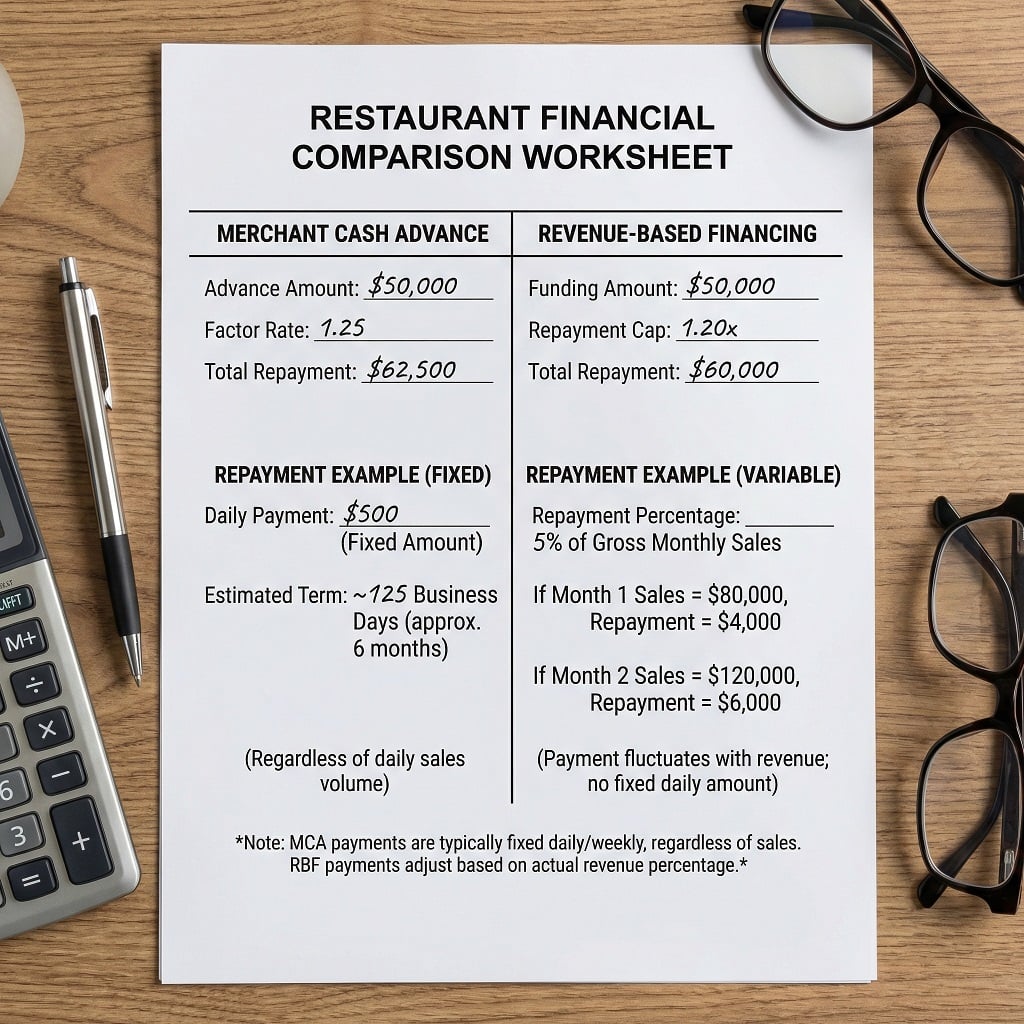
Repayment typically hits through fixed daily payments pulled from credit card receivables. When sales dip, the withdrawal still happens, which means your available balance shrinks whether it was a strong day or a weak one. After the initial relief of funding fades, that steady pull becomes the part you notice most.
A slow Tuesday does not change anything. A storm that keeps customers home does not matter either. Even a POS crash that wipes out a night of sales will not stop the withdrawal. The automated clearing house (ACH) withdrawal hits your account the next morning regardless.
This is where merchant cash advances differ from almost every other business funding option. The repayment schedule does not flex. It does not pause. It does not adjust to your reality.

Where Restaurants Feel It First
The impact usually shows up in day-to-day decision-making. When money is leaving constantly, restaurants tend to delay anything that is not immediately necessary, even when that delay costs more later.
Equipment repairs get pushed off because the walk-in is still running, barely. Inventory orders shrink to conserve cash. Staff hours get trimmed, and you hope service does not suffer. You push off that restaurant renovation another month, then another.
Operational expenses do not shrink when cash flow gets tight. Rent stays the same. Payroll has to be met. Suppliers still want payment. But the daily deduction takes its cut first, every single day, before you get to decide how to allocate what is left.
How Revenue-Based Financing Works Differently
Revenue-based financing also ties repayment to sales, but it generally scales with performance instead of staying fixed.
I did some research and found out that revenue-based financing lets businesses raise capital by giving investors a share of their ongoing gross revenues, with payments that vary based on performance rather than remaining fixed.
For restaurants dealing with revenue fluctuation, that variability reduces pressure during slower periods and accelerates repayment during stronger months. It is often viewed as a more forgiving cash flow solution, but the overall cost and timeline still depend on the terms.
When you have a great week, you pay more. When you have a terrible week, you pay less. Your repayment adjusts to match your sales performance, which aligns better with how restaurants actually operate.
The hospitality industry does not run on steady, predictable income. You have busy weekends and dead Mondays. You have summer rushes and winter slumps. You have holiday peaks and post-holiday crashes. Revenue-based financing accounts for that reality in a way MCAs do not.
But flexibility comes with tradeoffs. The total repayment amount often ends up higher than a traditional business loan because the funding provider is taking on more risk by letting payments flex. And because payments vary, it becomes harder to predict exactly when you will be free of the obligation.

Where Each Option Creates Stress
Both options create stress, just in different places.
With a merchant cash advance, stress comes from rigidity. Fixed daily repayment does not care about weather weeks, repairs, staffing gaps, or slow stretches. You watch your merchant account balance drop every morning and wonder if there will be enough left to cover the rest of your operational costs.
The mental toll adds up. You start dreading slow days before they even happen. You obsess over daily sales numbers. You make decisions based on fear instead of strategy. Cash flow management becomes a constant source of anxiety.
With revenue-based funding, stress shows up in cost and duration. Payments flex, but repayment continues until the cap is reached, and the total cost surprises owners who only look at the monthly pull.
You might pay less during a slow month, which feels like relief. But that relief extends the timeline. What you thought would take 12 months to repay might stretch to 18 or 20. The factor rate or percentage keeps pulling month after month, and the total paid keeps climbing.
Some restaurant owners find that trade-off worth it. Others realize too late that they would have been better off with a fixed loan term and predictable monthly payments, even if those payments were higher.
Hindsight is brutal when it comes to restaurant financing. One restaurant owner thought an MCA would solve a temporary cash flow problem. Instead, it locked them into daily withdrawals that strangled growth for over a year. They watched competitors expand while they fought just to stay current on repayment. The funding that was supposed to help nearly destroyed what they built. Want to learn exactly what went wrong and what they wish they had done instead? Read the full story in This Restaurant Used an MCA and Regretted It, Here’s What They’d Do Instead. Their mistakes could save you from making the same ones.
Key Questions Restaurants Should Ask Before Choosing
These questions usually reveal where the friction will hit later, without turning the decision into a long research project:
- How does this repayment structure behave during a slow month, not a strong one
- Do fixed daily payments leave room for payroll, inventory, and emergencies
- Who controls the repayment terms after signing
- How will this affect restaurant cash flow management during seasonal swings
- What flexibility exists if operational expenses spike unexpectedly
- What is the true total cost when calculated over the full repayment period
- Can I refinance or pay off early without penalties
- What happens if I need to switch credit card processing providers
- Does this funding show up clearly on my financial statements
- Will this impact my ability to get future business financing
Most MCA providers and revenue-based financing companies do not volunteer answers to these questions. You have to ask and if they dodge or give vague responses, that tells you something important.
A Side-By-Side Look At Both Models
Restaurant owners often compare merchant cash advances and revenue-based financing as if they solve the same problem in the same way. Both promise fast access to capital, and position themselves as alternatives to traditional bank loans. They are also marketed as flexible options for businesses with fluctuating revenue.
But speed alone does not define how a funding product behaves once repayment begins. The real difference shows up in how each model handles cash flow, control, and long-term flexibility. Looking at them side by side makes those distinctions easier to see.
| Feature | Merchant Cash Advance | Revenue-Based Financing |
| Repayment style | Fixed daily sales deduction | Percentage of revenue |
| Flexibility during slow periods | Low | Moderate to high |
| Funding speed | Quick funding | Fast |
| Control over terms | Provider-led | Provider-led |
| Impact on cash flow management | Constant pressure | Variable |
| Total cost transparency | Low | Medium |
| Effect on business credit | Often unreported | Varies |
| Ability to refinance | Limited | Limited |
This is the part most restaurants miss. Both options move fast, but neither necessarily gives the owner meaningful control over the terms.
In the end, you accept what the lender puts in front of you. The rules are theirs, not yours. And instead of certainty, you are left hoping the numbers work out.

How A Hybrid Approach Fits Restaurants Better
A hybrid approach keeps the cash flow alignment restaurants like, but it changes who sets expectations first.
Instead of reacting to preset offers, the restaurant owner defines the funding amount they need and the repayment range they realistically handle. Lenders respond within that range, which keeps the business in the driver’s seat.
Think about how different that feels. There is no begging for capital or scrambling to accept whatever terms get thrown at you. Instead, you set your needs and limits upfront and let lenders respond to that.
This shifts the power dynamic completely. You start from a position of control instead of desperation. You compare offers instead of grabbing the first one. You walk away if nothing fits instead of forcing a bad deal.
What Changes When The Owner Sets The Terms First
When the owner sets the terms upfront, the decision becomes less about grabbing the fastest money and more about protecting business cash flow while still accessing working capital.
The process starts with defining what works for your restaurant business model. Repayment levels reflect real margins and leave room for payroll, inventory, and unexpected costs. Instead of maxing out every dollar, you build in breathing room from the beginning.
Lenders respond to what you asked for, not what they want to sell. If their offer does not match your needs, you know immediately. There is no wasted time, pressure, or signing documents you barely understand.
The funding you accept fits your restaurant operations from day one. There would be no need to try to squeeze your business into someone else’s box because you built the box yourself.

Where Dine Well Financial Fits In This Comparison
Dine Well Financial operates in that middle ground. Restaurant owners start by naming their own rate and repayment comfort level, then Dine Well shares that request with a network of restaurant-focused lenders.
Offers come back aligned to what the restaurant asked for. Owners compare options, adjust, or walk away. The result is restaurant financing that supports business growth without forcing the restaurant into a structure it did not choose.
The result is flexibility without losing control of the terms. You move quickly without locking yourself into rigidity. And instead of confusion, you gain transparency and real choice.
We do not push products. What we do here is create a funding marketplace where restaurant owners set the rules and lenders compete to meet them. That is how restaurant financing should work.
Choose The Option That Protects Your Cash Flow
When speed is the only thing that matters, a business cash advance can look appealing. Prioritize flexibility, and revenue-based financing may ease some short-term pressure. But if you care about aligning capital with cash flow while keeping control of the deal, a hybrid approach usually makes more sense.
Your restaurant deserves funding that matches how you actually operate. It should reflect your margins, sales volume, seasonal swings, and growth plans, not a lender’s template or an algorithm’s assumptions about what you qualify for.
Daily payments that never adjust to your reality can box you in fast. Flexible payments sound better, but not if the cost keeps piling up long after you expected to be done. Choose funding where you set the terms first.
If you are weighing restaurant financing options, we at Dine Well Financial invite restaurant owners to reach out for a straightforward conversation about cash flow, repayment comfort, and terms that match how restaurants actually operate. No pressure, just clarity before you commit.
Disclaimer: Dine Well Financial is not a lender and does not provide merchant cash advances or business loans directly. We are a funding network that connects restaurant owners with third-party lenders and capital providers. All financing offers are subject to lender approval and applicable underwriting criteria. “Name your rate” is a non-binding feature that allows business owners to propose preferred repayment terms; actual offers may differ based on creditworthiness, business performance, and lender discretion. Dine Well Financial makes no guarantees regarding funding availability, terms, or lender acceptance. Always consult with a financial advisor or legal professional before entering into any financing agreement.

Daniel Harper writes about restaurant financing, merchant cash advance risk, and cash flow strategy for Dine Well Financial. His work focuses on helping independent restaurant owners compare funding options with clear numbers before they sign anything. He has covered alternative lending for the food service industry since 2019. More from Daniel Harper.
Stuck in an MCA or comparing funding options?
You shouldn’t have to wait weeks for what you need today. Call now or apply online in minutes. With our easy application, many clients receive funds in just a few days, subject to lender approval and qualifications.
Leave a Reply